The home game
How to play poker with friends
A home poker game needs four things: a 52 card deck, something to use as chips, a table everyone fits around, and between three and eight people. That is enough to play. Everything else is a set of agreements worth making before the first hand is dealt, rather than halfway through the third.
This is written for the first night: how many people, how to hand out chips that are worth nothing, how the button moves around, and the three arguments that always come up.

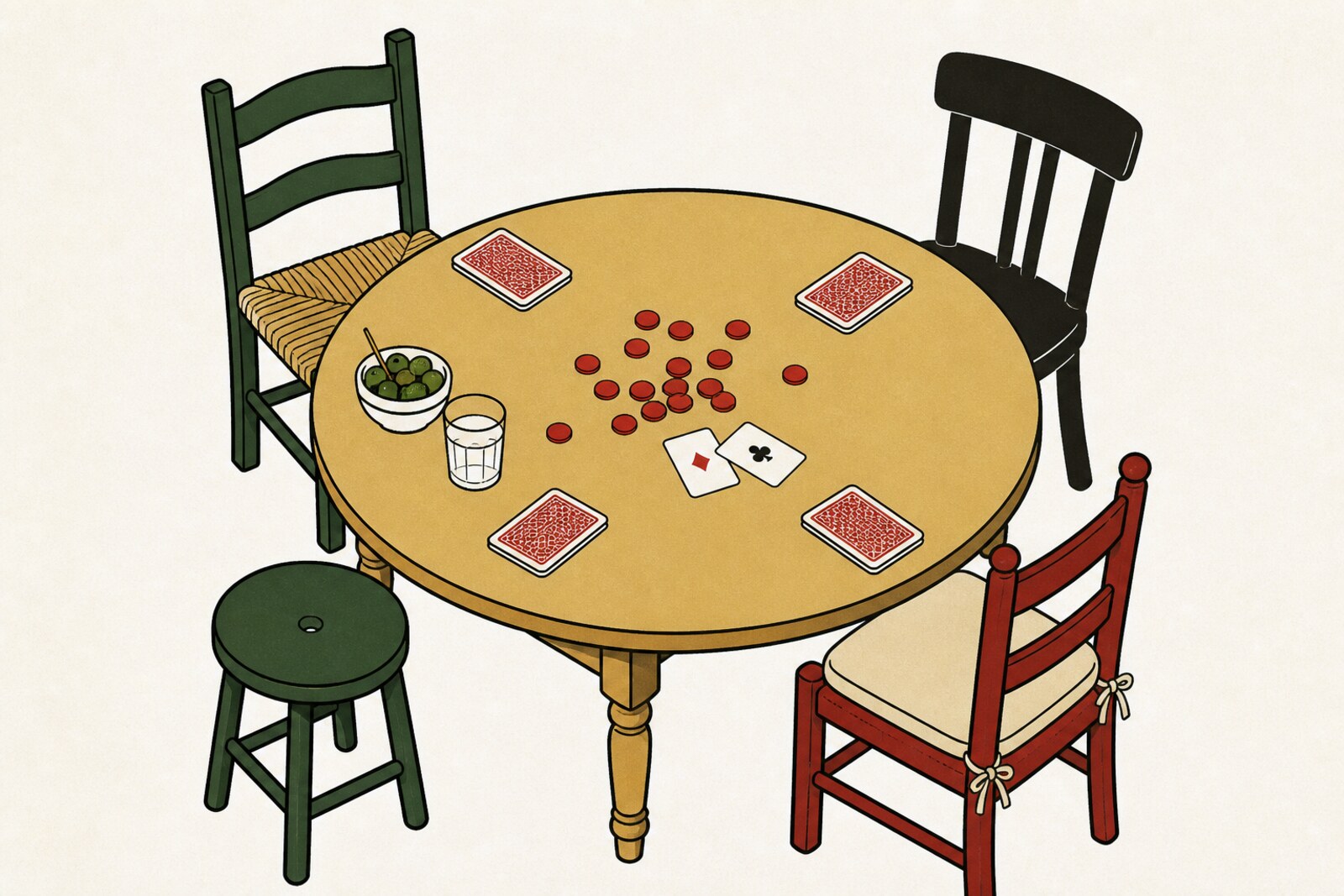
How many people
Poker works from two players up, but the first night is better with more.
-
Two
It works and it is fast, but you have to decide on every single hand and it wears you out. Good for practice, not for a whole evening.
-
Four to six
The right number. Enough hands that nobody gets bored, and enough waiting that there is time to watch what everyone else is doing.
-
Seven or eight
It fits, but each person plays far less and the hands get slow. At eight it starts to be worth having someone who only deals.
What you need
- A deck of 52 cards
- The standard one, with spades, hearts, diamonds and clubs. Two decks with different backs is better still: while one is being played, the next dealer shuffles the other, and the night stops dragging.
- Chips, or anything that behaves like chips
- Plastic chips if you have them. If not: coins, matchsticks, dried beans, pieces from a board game. It does not matter what they are as long as they can be told apart and there are enough.
- Something to use as the button
- A small object that sits in front of whoever is dealing that hand: a coin, a lighter, a bottle cap. It looks trivial and it prevents half the arguments.
- A table where everyone can see everyone
- Round beats long. People need to see the cards in the middle and, above all, how many chips each player has in front of them. That is information, and it is part of the game.
Handing out chips that are worth nothing
This is where most home games go wrong before they start. A chip does not have to stand for money. It can be what it is: the unit that measures who is ahead.
-
1
Everyone starts with the same
Two hundred chips each is a good number if they are all one colour. If you have several colours, give everyone the identical stack in the identical proportions.
-
2
The two forced bets are one chip and two
On every hand, two players put chips in before seeing a card. They are called blinds: the small one is a chip, the big one is two. They exist so there is always something in the middle worth playing for. Two hundred chips is a hundred big blinds each, which is the depth serious games are played at.
-
3
Raise the blinds only if you want it to end
If the night has a finishing time, double the blinds every forty minutes: one and two, then two and four, then four and eight. Hands get bigger and the game ends by itself. If nobody is in a hurry, leave them alone all night.
-
4
At the end they go back in the box
Whoever finishes with the biggest stack won the night. Chips convert into nothing, carry over into nothing and are owed by nobody. That is the deal, and it is worth saying out loud before the first hand.
If someone runs out and you want them to keep playing, give them the starting stack again and note that they are on their second. Nothing wrong with that: the only rule is that everyone knows in advance it is allowed.
How the button moves
The button marks who deals that hand and, more importantly, who acts last, which is the best seat at the table. That is why it has to move: leave it still and one person plays the whole night with an advantage.
-
To start, deal one card face up to each player. Highest card takes the button for the first hand.
-
The small blind is posted by the player to the left of the button. The big blind by the next one along. After the deal, the player after that acts first.
-
When the hand ends, the button moves one seat to the left, and the blinds move with it. After a full lap everyone has paid the same and everyone has acted last once.
-
Whoever has the button shuffles and deals, always starting on their left. If you would rather one person dealt all night, that is fine: the button still rotates, because what rotates is the turn, not the chore.
The three arguments of the first night
They always happen, they happen in this order, and all three have short answers. Worth reading beforehand, because having them out with chips already in the middle is far worse.
-
1
Nobody knows how much you are allowed to raise
Someone bets four, the next player wants to raise, and the game stops. Five? Double? Everything in front of them?
One rule covers it: a raise has to be at least double the bet you are raising, and the maximum is everything you have in front of you. Four in the middle means you raise to eight or more. And you can never bet money that is not already on the table: you play the chips you have, nothing else.
-
2
Someone runs out of chips mid hand
They have six chips left, the bet is twenty, and they want to carry on. Everyone looks at each other.
They put in the six and stay in the hand. Nobody is obliged to put in what they do not have. Their six compete for the pot as it stood at that moment, and the remaining fourteen go into a separate pile that only the other players are contesting. At the end, the short player can win the main pot, and the best of the rest takes the side pot.
-
3
Two players make the same hand and the trial begins
Both have a pair of kings. One claims the win because his kings are spades. Half the table agrees with him.
Suits never break a tie in poker. With the same hand you compare the highest card alongside it, then the next, up to five cards. If all five are genuinely equal, the pot is split down the middle. If a chip is left over when splitting, it goes to whoever sits closest to the button on its left.
Three agreements that save arguments
- People act in turn and in order. Anyone who acts early gives the table free information, whether they meant to or not.
- Cards that get folded are not shown until the hand is over. Showing what you threw away changes what the players still in the hand do.
- The finishing time is agreed before the first hand. A game with no agreed end always ends badly, and almost never because of the cards.
And if you are the one who is lost
Almost everyone arrives at their first game having read the rules and with no idea what to do when it is their turn. It shows, and they know it shows. Reading the rules again does not fix that. Making a lot of decisions with someone telling you whether you got them right does.
A course from zero, no money and no casino.