Poker terms and slang
Poker terms are the words players use for the cards, the bets and each other. Here are 118 of them, from check, call and fold to straddle, 3-bet and the nuts, each explained in two lines of plain English, plus the slang you'll hear at a home game, in a card room or on a stream.
118 terms 9 topics 39 slang words you'll hear
Nine topics, from the deal to the card room
Pick a topic to jump to its words. The ones the course teaches are shown on the table, as their lesson shows them.
- The cards 11 terms Deck · Suit · Rank · Face cards…
- A hand, street by street 11 terms Hand (one deal) · Dealer · Burn card · Preflop…
- Actions 17 terms Fold · Check · Call · Bet…
- Seats and position 15 terms Button · Blinds · Small blind · Big blind…
- Hands and draws 15 terms Hand (your best five) · Kicker · Playing the board · Top pair…
- Chips and pots 11 terms Chip · Stack · Short stack · Effective stack…
- Odds and strategy 8 terms Pot odds · Implied odds · Equity · Expected value…
- Players and slang 12 terms Tight · Loose · Aggressive · Passive…
- Games and room rules 18 terms Home game · Cash game · Tournament · Buy-in…
No word matches. Try another one or open the index.
The cards
The deck, the two cards you're dealt and what everything is called.
- Deck
-
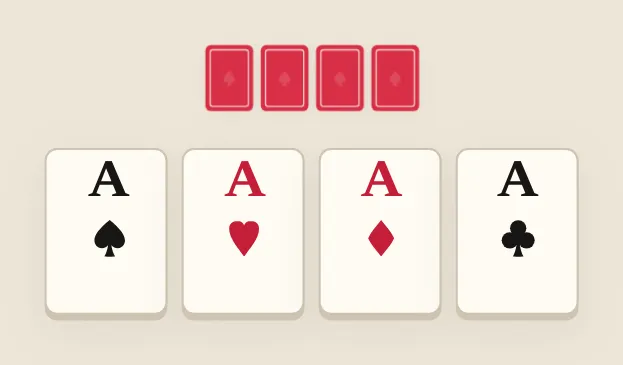
- A deck is the 52 cards poker is played with: four suits of thirteen ranks each, from the 2 up to the ace, with no jokers.
- Hold'em uses a single deck, shuffled before every hand; jokers only turn up in a few home games, as wild cards.
- In depth How many cards in a deck →
- Suit
-
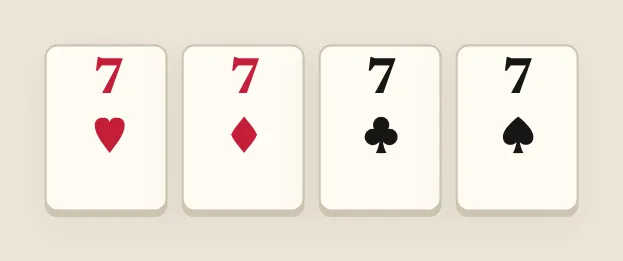
- A suit is one of the deck's four families: spades, hearts, diamonds and clubs, with thirteen cards in each.
- In Hold'em no suit outranks another: two hands of the same value split the pot, whatever their suits.
- Rank
-
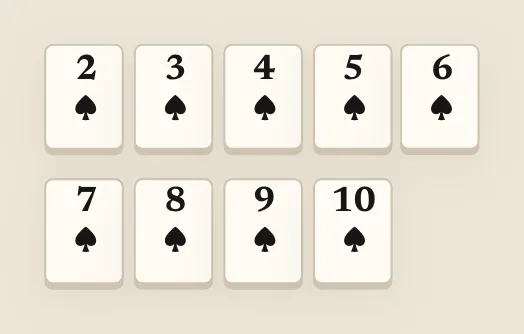
- Rank is a card's value, from the 2, the lowest, up through the 10, jack, queen, king and ace.
- The ace is the highest card, and it can also play low, below the 2, in the straight A-2-3-4-5.
- Face cards
-
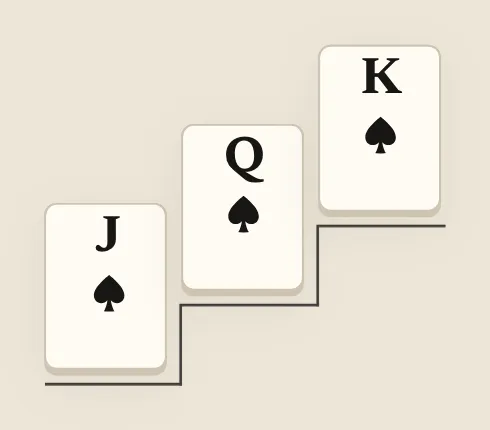
- Face cards are the jack, the queen and the king, the three cards with a figure drawn on them.
- The ace isn't a face card, even though it outranks all three, and neither is the 10.
- Hole cards
-
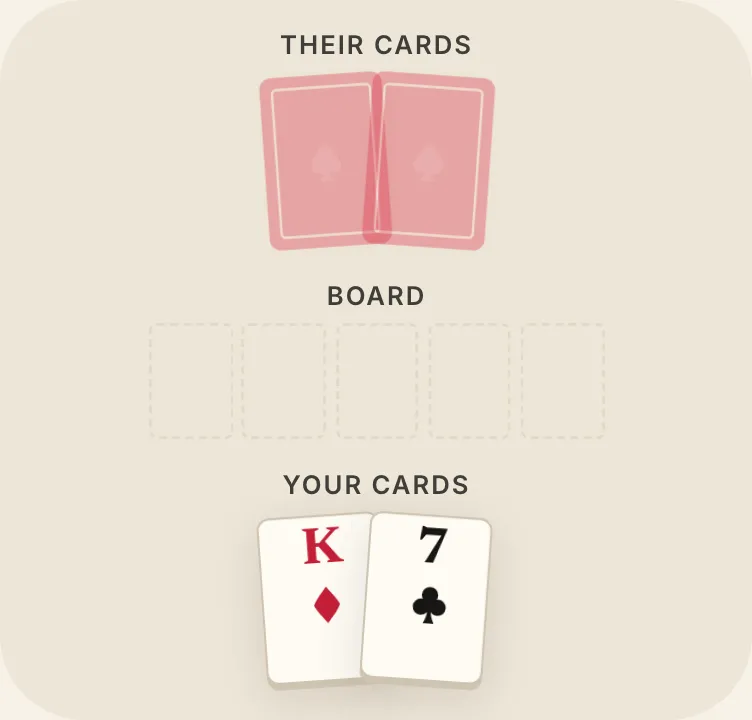
- Your hole cards are the two cards dealt to you face down at the start of a hand, which only you get to see.
- Everything else is on the board and belongs to everyone, so these two are what makes your hand different from anyone else's.
- Board
-
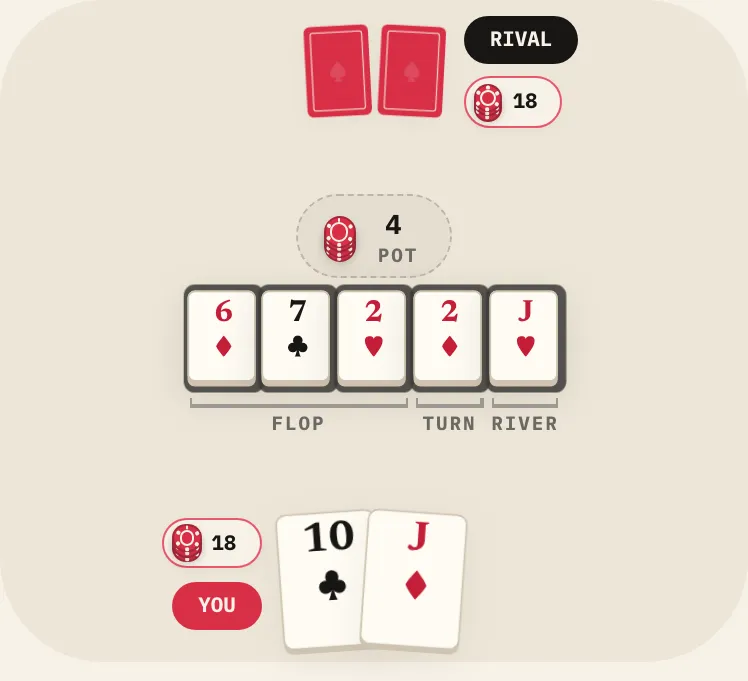
- The board is the five community cards dealt face up in the middle of the table, which every player can use.
- It comes out in three steps, the flop, the turn and the river, and because it's shared, two players can end up with the same hand.
- In depth Flop, turn and river →
- Pocket pair
-
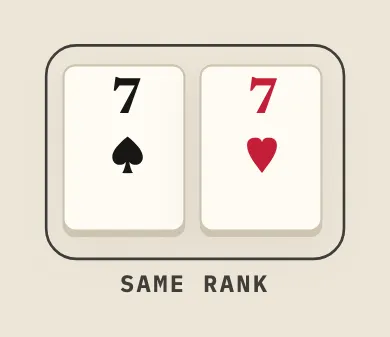
- A pocket pair is two hole cards of the same rank, like two sevens or two aces.
- You're dealt one about once every 17 hands; pocket aces, the best of them, about once every 221.
- Slang pocket rockets · cowboys · ladies · hooks · snowmen · ducks
- Suited
-
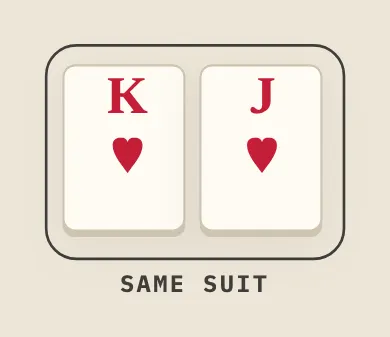
- Suited describes two hole cards of the same suit, like the king and jack of hearts.
- It makes a flush possible, but only about one time in sixteen, even when you see all five cards of the board.
- Offsuit
-
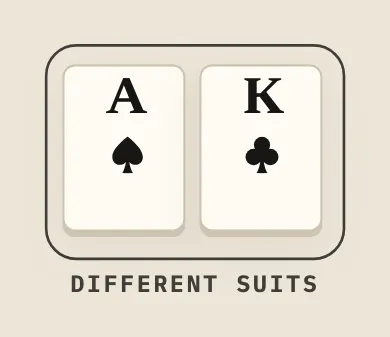
- Offsuit describes two hole cards of different suits, like the ace of spades and the king of clubs.
- Hands are often written with an s or an o: AKs is ace-king suited and AKo is ace-king offsuit.
- Slang the hammer
- Connectors
-
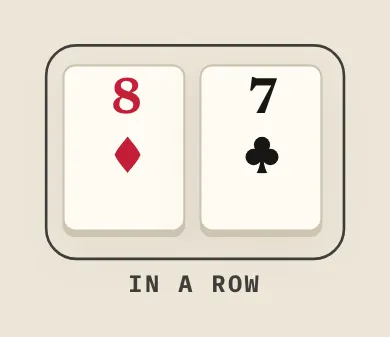
- Connectors are two hole cards of consecutive rank, like an 8 and a 7 or a jack and a 10, which can make a straight together.
- When they also share a suit they're suited connectors, which can make straights and flushes.
- Broadway
-
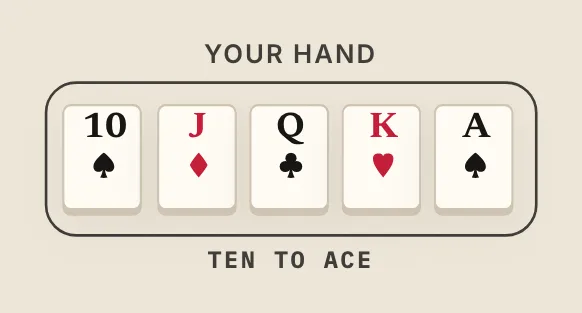
- Broadway cards are the 10, jack, queen, king and ace, and Broadway is also the straight those five make, the highest one there is.
- Two of them in your hand, like king-queen or ace-jack, are one of the most common reasons to play a hand.
- Slang big slick
A hand, street by street
Everything that happens from the deal to the showdown, in order.
- Hand (one deal)
-
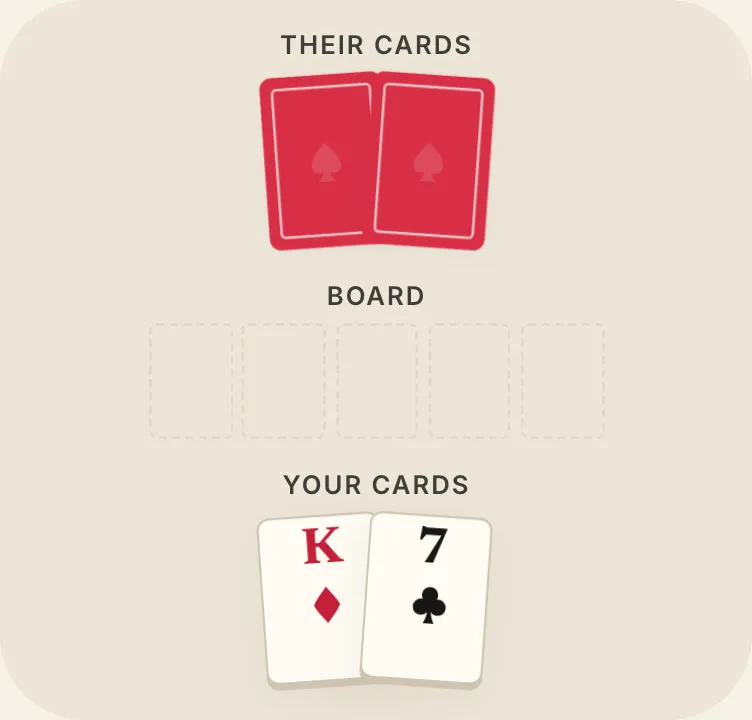
- A hand is one complete deal, from the shuffle to the moment someone takes the pot.
- A night of poker is hundreds of hands, dealt one after another; the word's other sense is the five cards you play.
- Dealer
- The dealer is whoever shuffles and deals the cards: in a card room, a staff member who also runs the pot and never plays.
- In a home game the player with the button deals, so the job moves one seat to the left every hand.
- In depth How to deal poker →
- Burn card
- A burn card is the top card of the deck, discarded face down before the flop, the turn and the river are dealt.
- It's protection: if anyone glimpsed the top card, that card never reaches the board.
- In depth How to deal poker →
- Preflop
-
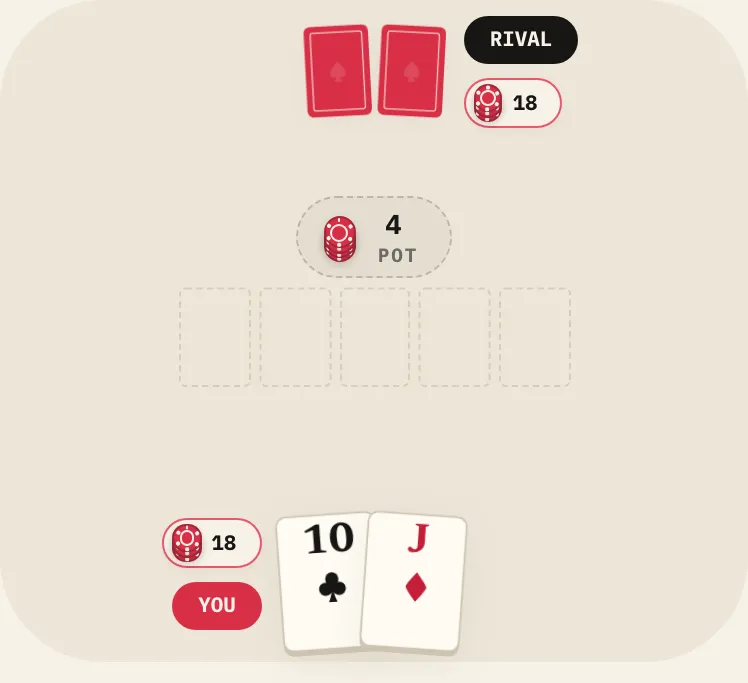
- Preflop is the first betting round, played after the hole cards are dealt and before any card goes on the board.
- It's the only round that starts with chips already in, the blinds, and it begins with the player to the left of the big blind.
- In depth Flop, turn and river →
- Flop
-
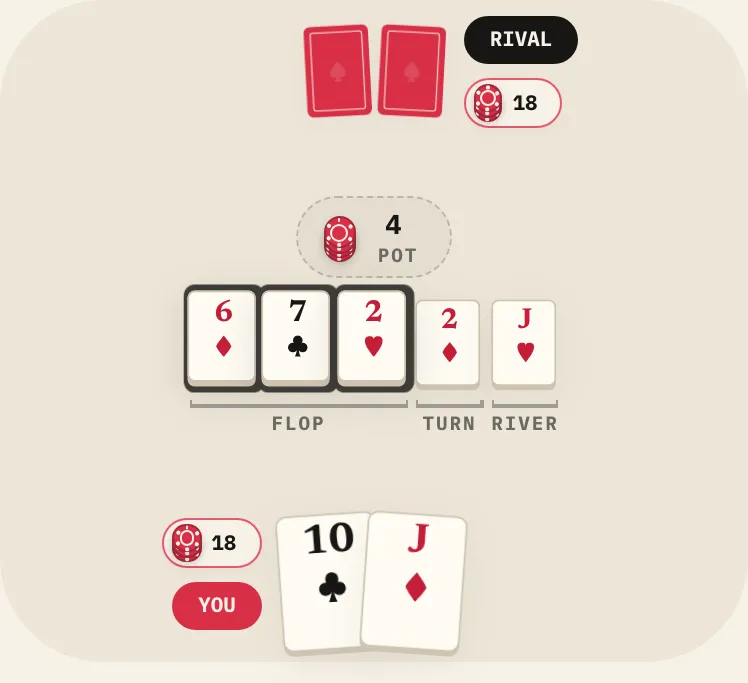
- The flop is the first three community cards, dealt face up together once the preflop betting is over.
- You now see five of the seven cards you'll have, which is why it's the street that changes hands the most.
- In depth Flop, turn and river →
- Turn
-
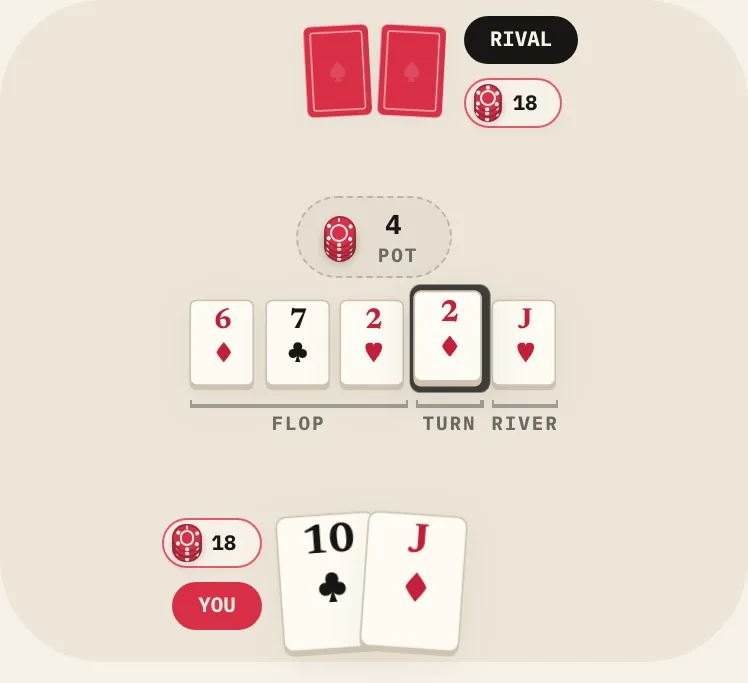
- The turn is the fourth community card, dealt on its own once the betting on the flop is over.
- It's also called fourth street, and it's often the card that decides whether a draw is still worth chasing.
- Slang fourth street
- In depth Flop, turn and river →
- River
-
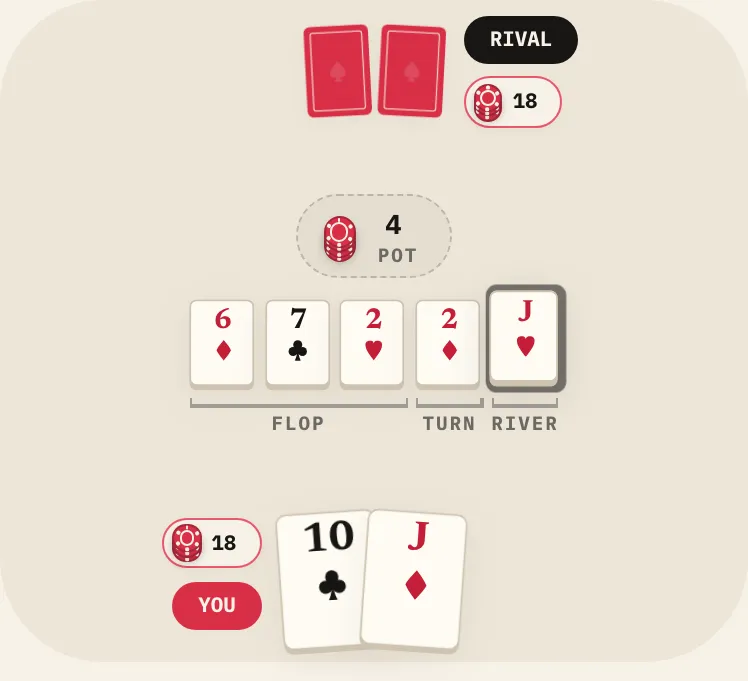
- The river is the fifth and last community card, after which no one's hand can improve.
- One more betting round follows, and if two or more players are still in after it, the hand goes to a showdown.
- Slang rivered
- In depth Flop, turn and river →
- Street
-
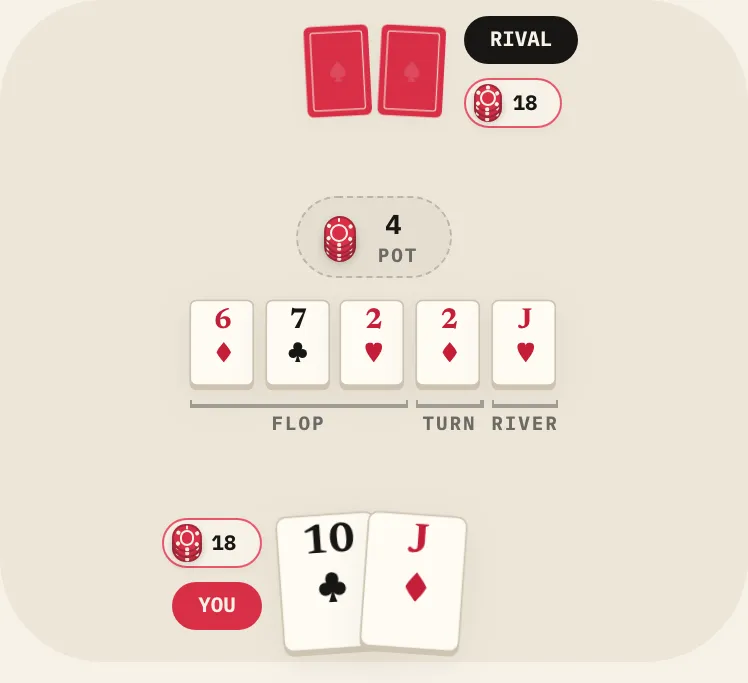
- A street is each of the four betting rounds in a hand of Hold'em: preflop, the flop, the turn and the river.
- On each street the betting goes on until everyone still in has put in the same amount, folded or gone all-in.
- In depth Flop, turn and river →
- Act
-
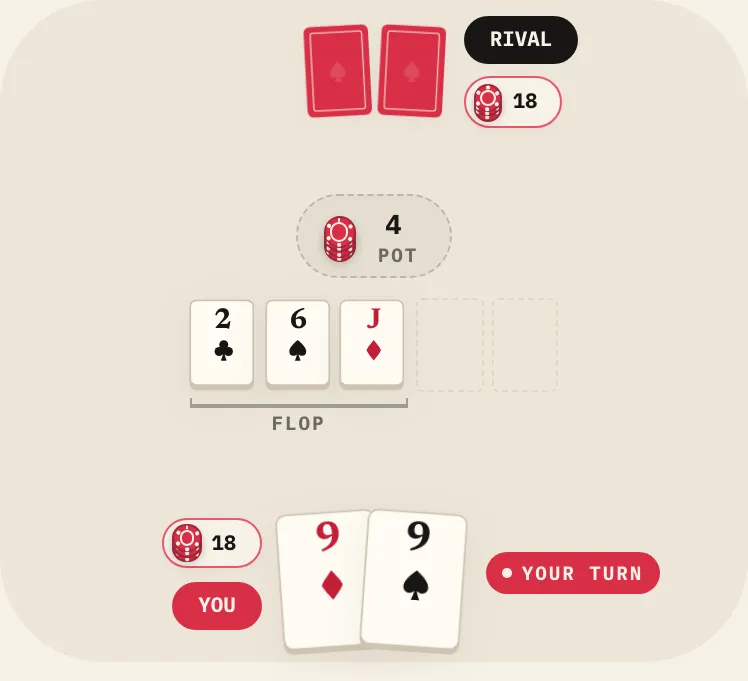
- To act is to make your decision when it's your turn: fold, check, call, bet or raise.
- Players act one at a time, clockwise, and “the action is on you” means it's your turn.
- Slang tank · hollywood
- In depth Check, bet, call, raise, fold →
- Showdown
-
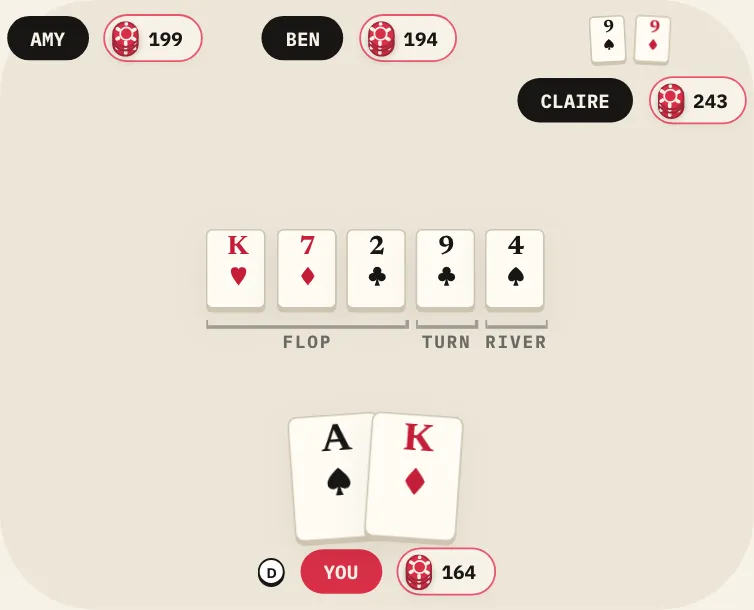
- The showdown is the end of a hand, when two or more players are left after the last bet and the best hand shown takes the pot.
- The last player to bet or raise on the river shows first; if the river was checked through, the first player still in the hand to the left of the button does.
- Slang slow roll
- In depth Who wins in poker →
- Muck
- The muck is the pile of folded and burned cards, and to muck is to throw your cards into it without showing them.
- A hand that reaches the muck is normally dead, so never throw away a hand you think might win.
Actions
The five things you can do on your turn, and the plays built out of them.
- Fold
-
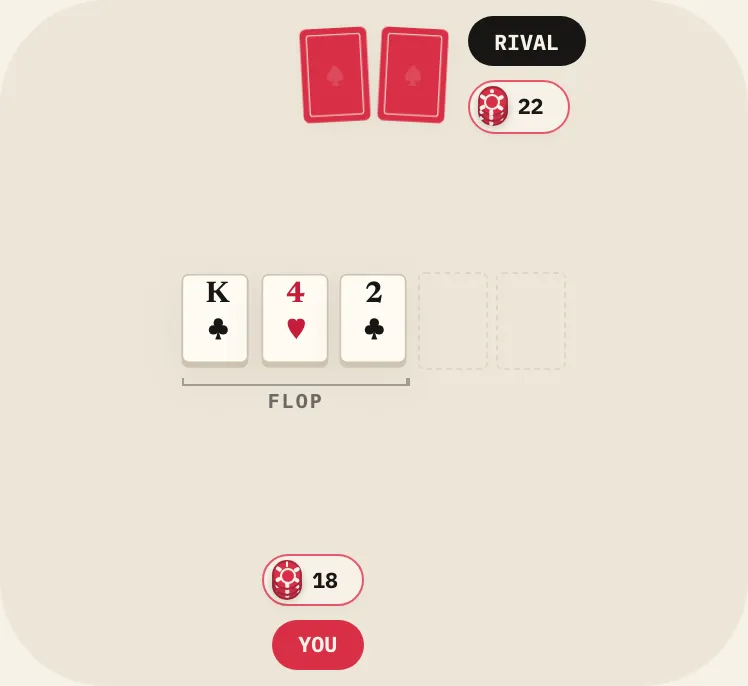
- To fold is to give up your hand: you lose whatever you've already put in the pot, and not one chip more.
- It's the action you'll take most often, and folding when you could check for free is the one fold that's always a mistake.
- In depth Check, bet, call, raise, fold →
- Check
-
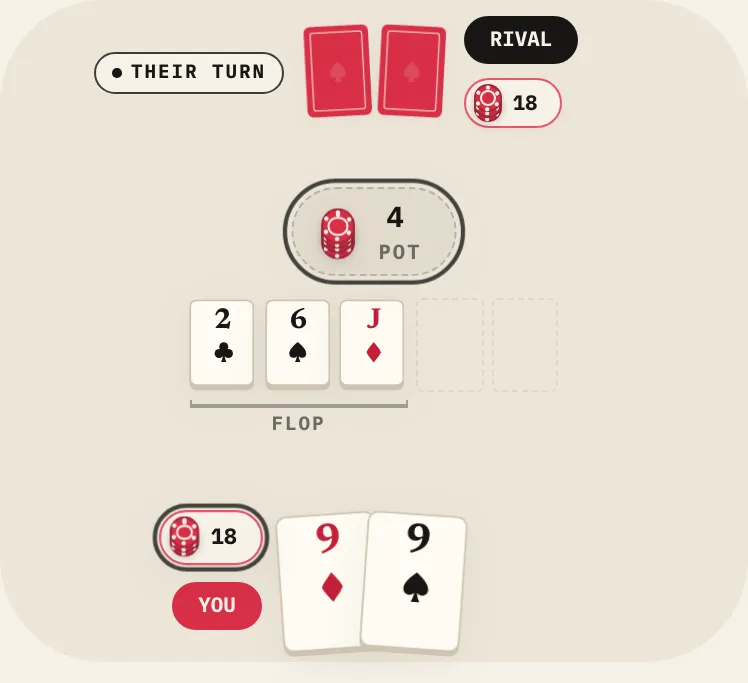
- To check is to stay in the hand without putting in chips, which you can only do when no one has bet before you on that street.
- Before the flop only the big blind can check, and only if no one has raised.
- In depth Check, bet, call, raise, fold →
- Call
-
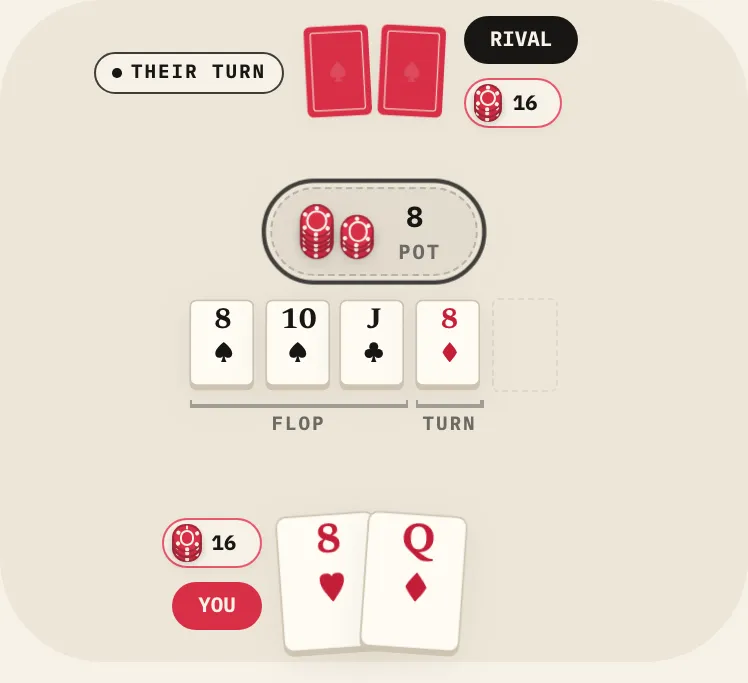
- To call is to put in exactly enough chips to match the current bet and stay in the hand.
- A call ends the betting round only if no one after you still has to act: before the flop, for instance, the big blind can still raise.
- Slang snap call
- In depth Check, bet, call, raise, fold →
- Bet
-
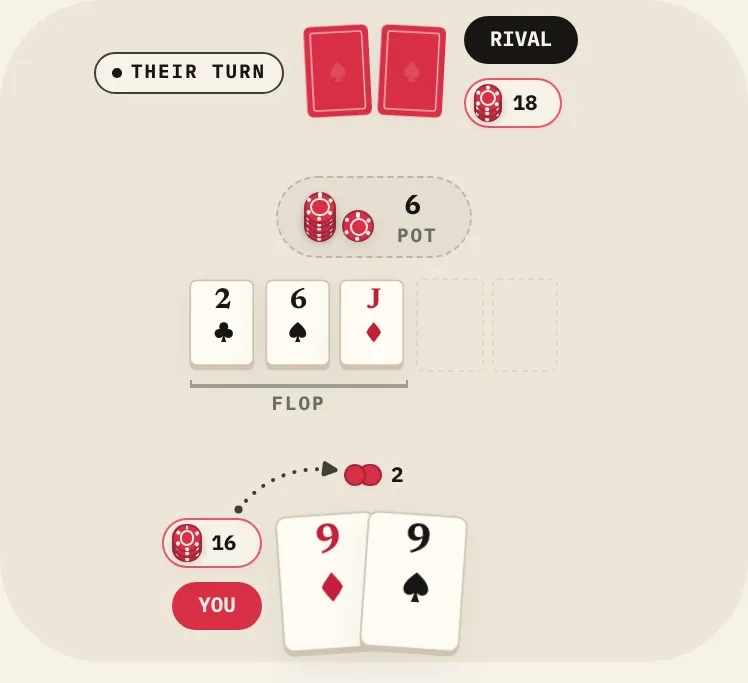
- To bet is to put chips in when no one has yet on that street, which makes everyone else call, raise or fold.
- In no-limit the smallest bet is the big blind, and before the flop the blinds already count as the bet: there you don't bet, you open.
- In depth Check, bet, call, raise, fold →
- Raise
-
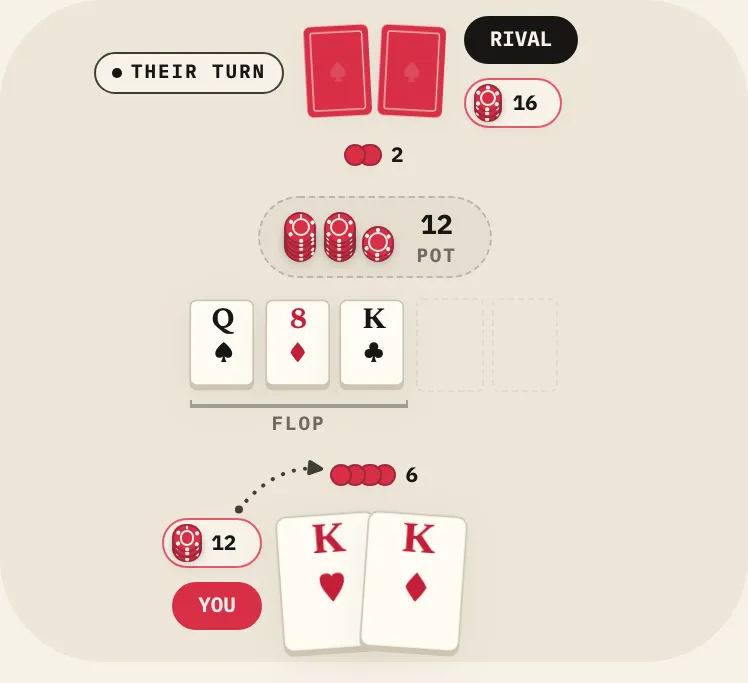
- To raise is to increase the bet someone else has made, so everyone who wants to stay in has to match the new amount.
- A raise has a minimum: it must add at least as much as the last bet or raise on that street added.
- In depth Check, bet, call, raise, fold →
- All-in
-
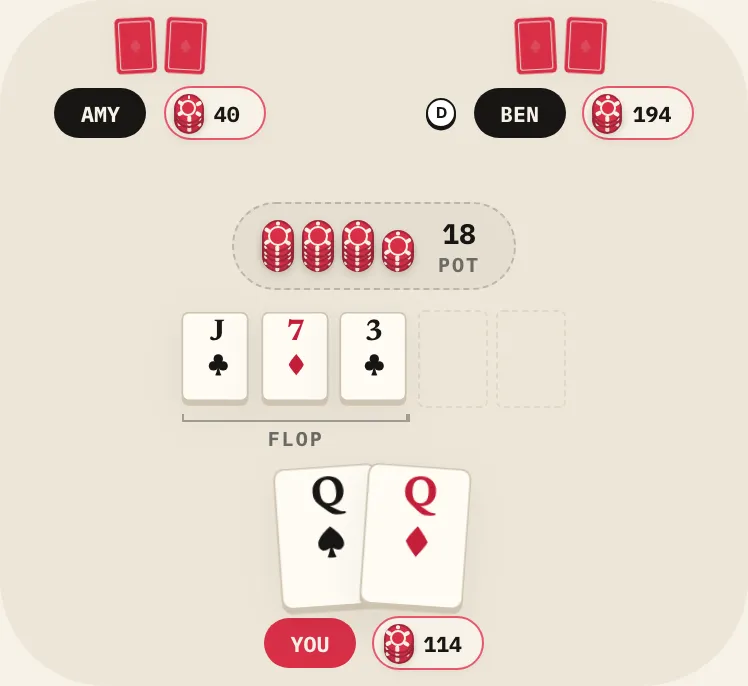
- All-in is putting every chip you have left into the pot, after which you make no more decisions in that hand.
- No one can make you bet more than you have; if others still have chips, they keep betting among themselves into a side pot.
- Slang shove
- In depth Side pot calculator →
- Open
-
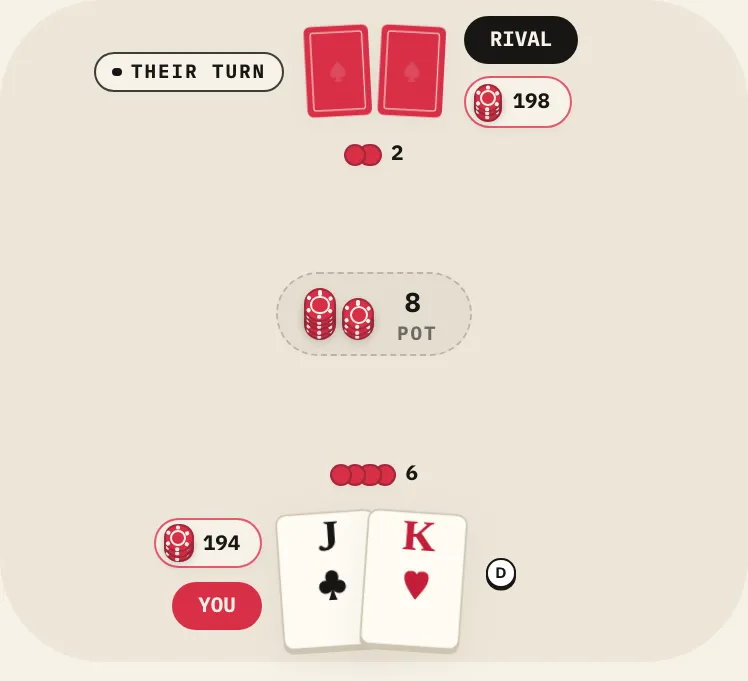
- To open is to make the first raise before the flop, when everyone who acted before you has folded.
- Coming in by just calling the big blind instead is called a limp.
- Limp
-
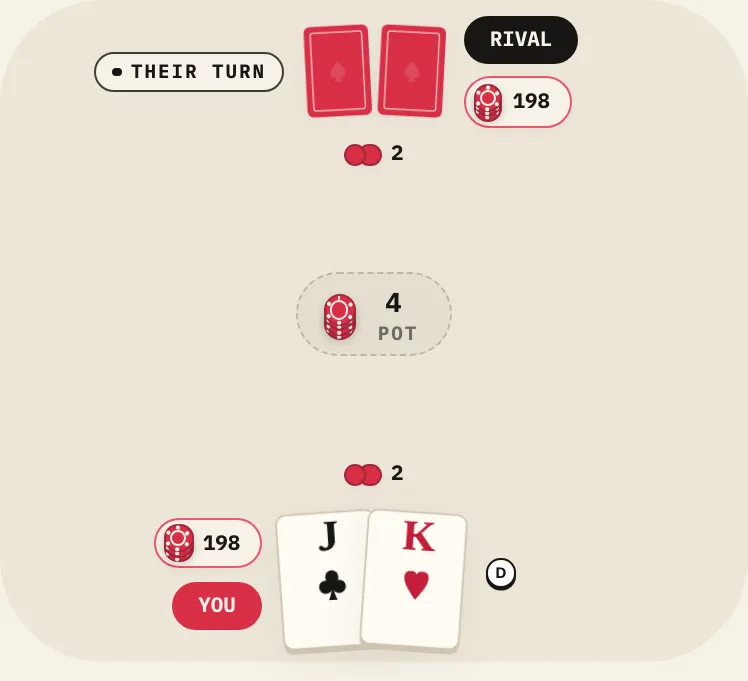
- To limp is to enter the pot before the flop by just calling the big blind instead of raising.
- It's common in home games and rare among strong players, who prefer to come in raising.
- Slang limper
- Minimum raise
-
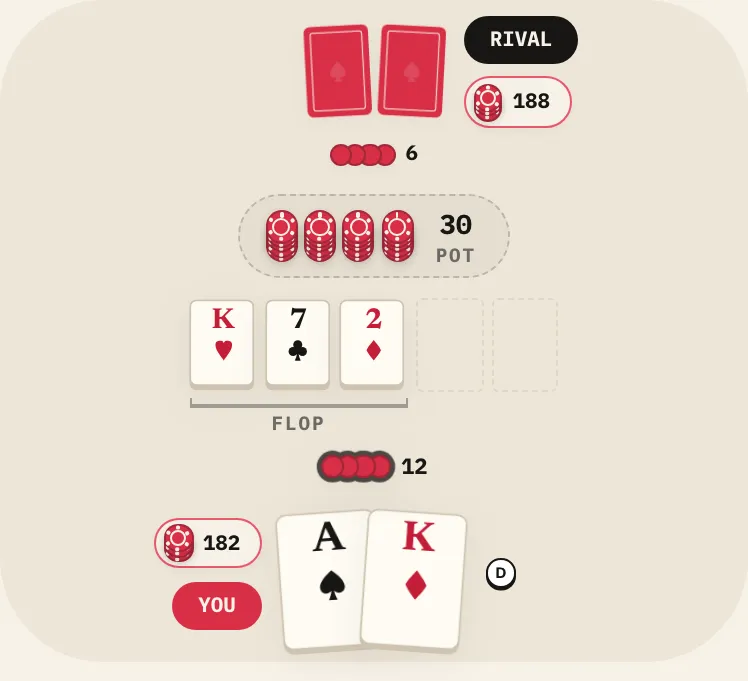
- The minimum raise is the smallest raise allowed: you match the current bet and add at least the size of the last bet or raise on that street.
- With blinds of 1 and 2, the first raise goes to at least 4; if someone then raises from 4 to 10, the next raise must go to at least 16.
- In depth Check, bet, call, raise, fold →
- 3-bet
-
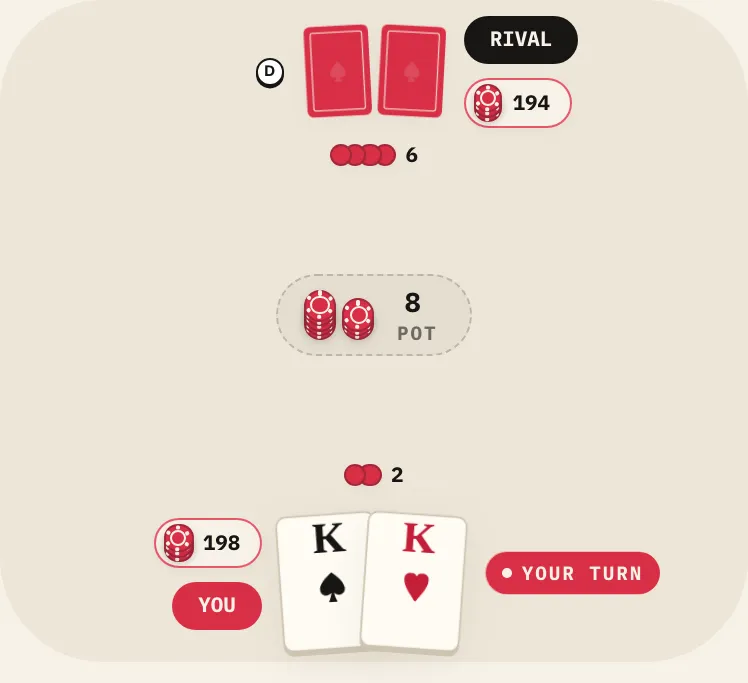
- A 3-bet is a re-raise: the third bet of a betting round, counting the big blind as the first one before the flop.
- So the open is the second bet and the raise over it is the 3-bet; the raise after that is a 4-bet.
- Check-raise
- A check-raise is checking on a street and then raising when someone behind you bets.
- It's legal in almost every game, though a few home games ban it, so ask before you try one.
- C-bet
-
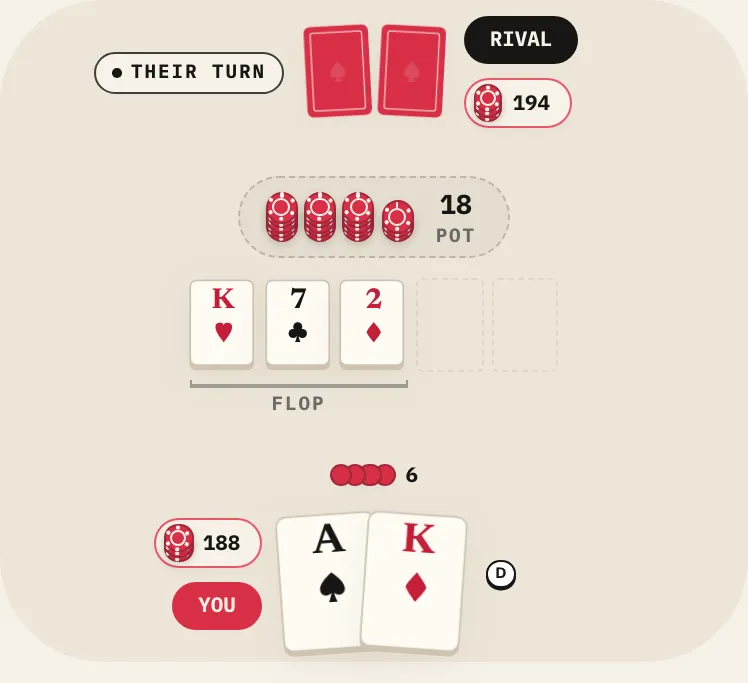
- A c-bet, short for continuation bet, is a bet on the flop by the player who made the last raise before the flop.
- It carries on the story the raise started, whether or not the flop actually helped.
- Value bet
-
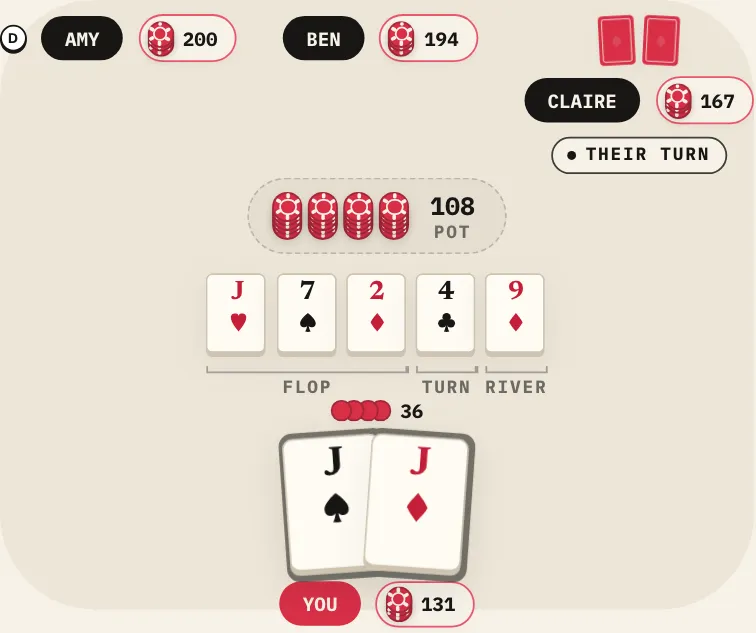
- A value bet is a bet made with a strong hand, hoping to be called by a worse one.
- It's the opposite of a bluff: you want the call, not the fold.
- Bluff
-
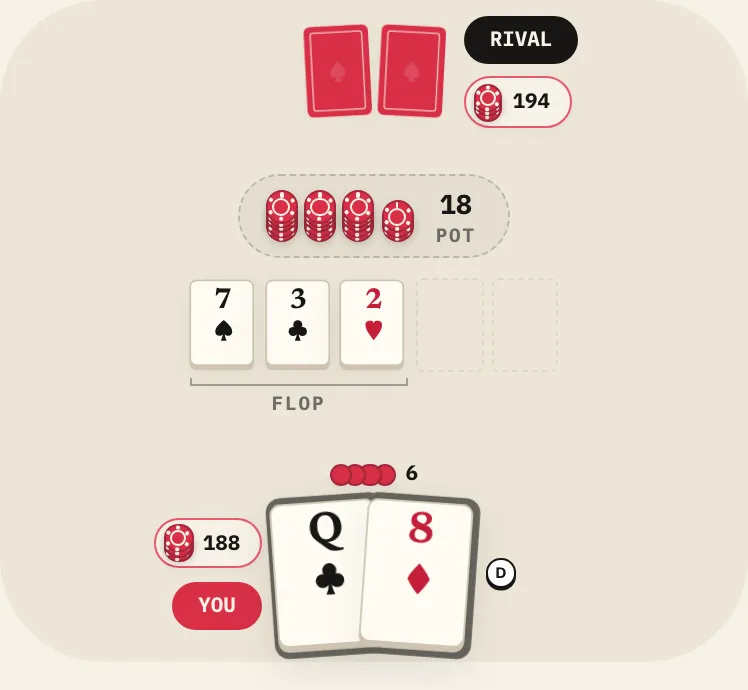
- A bluff is a bet or raise with a hand that would probably lose at showdown, made so that a better hand folds.
- It works only because no one can see your cards, and it's a normal part of the game, not a trick.
- In depth What is a bluff →
- Semi-bluff
-
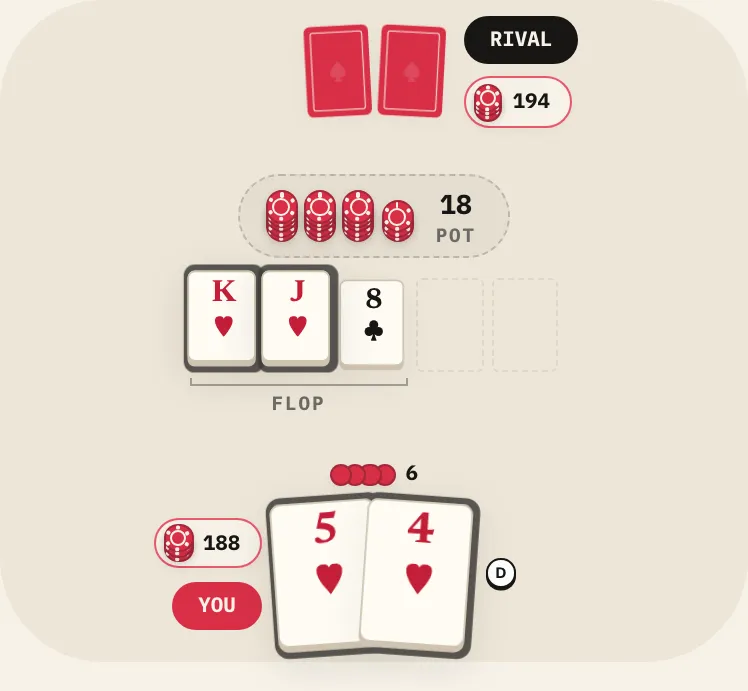
- A semi-bluff is a bluff with a draw: a hand that's behind right now but can still improve to the best one.
- It can win two ways, right away if everyone folds, or later if the card you need arrives.
- In depth What is a bluff →
- Slow play
- To slow play is to check or call with a very strong hand instead of betting, so opponents don't see the strength coming.
- It backfires when it hands out a free card that beats you.
- Slang sandbagging
- Hero call
- A hero call is a call with a weak hand that can only beat a bluff, made because you believe your opponent is bluffing.
- When it works it looks brilliant; when it doesn't, it was just a call.
Seats and position
Where you sit decides when you act, and that decides a lot.
- Button BTN
-
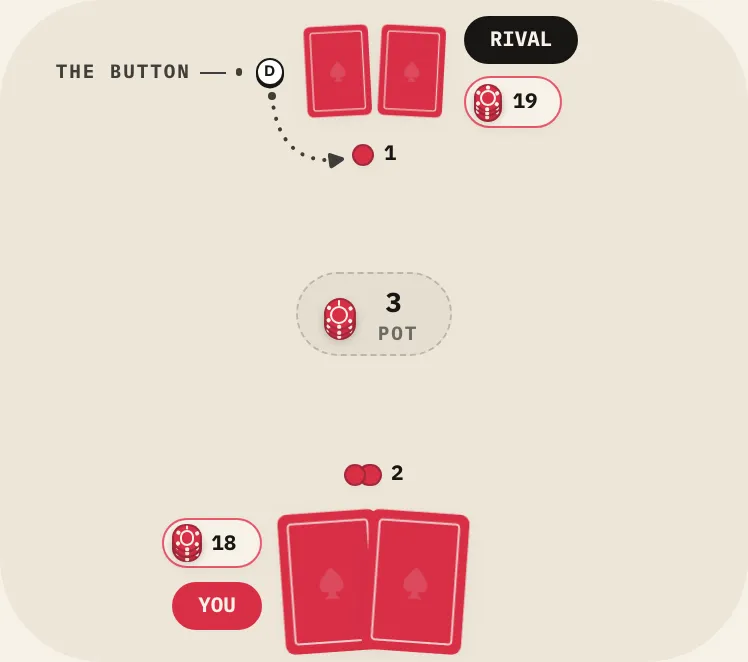
- The button is the disk that marks the dealer's seat, and the player who has it acts last on the flop, the turn and the river.
- It moves one seat to the left every hand, so everyone gets the best seat at the table in turn.
- In depth Poker positions →
- Blinds
-
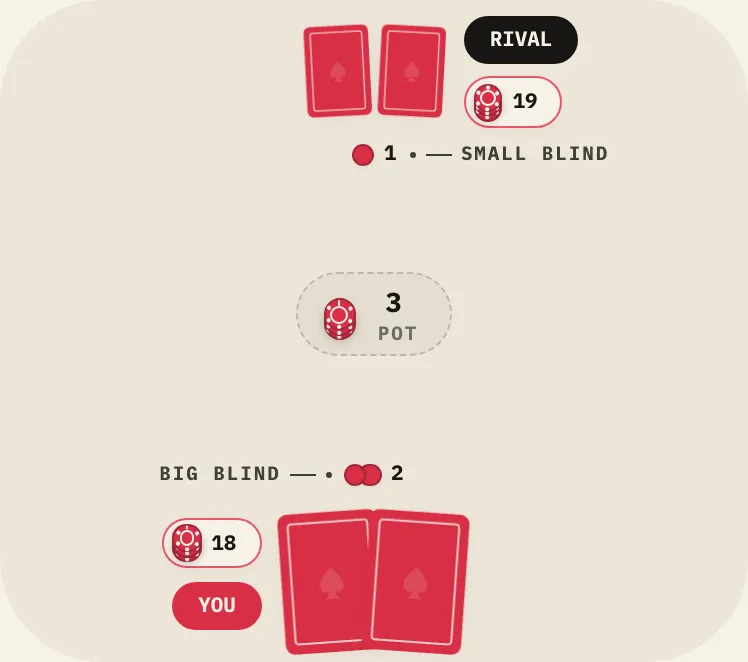
- The blinds are two forced bets posted before the cards are dealt by the two players to the left of the button.
- They make sure every hand has something to win; with only two players, the button posts the small blind.
- In depth Small blind and big blind →
- Small blind SB
-
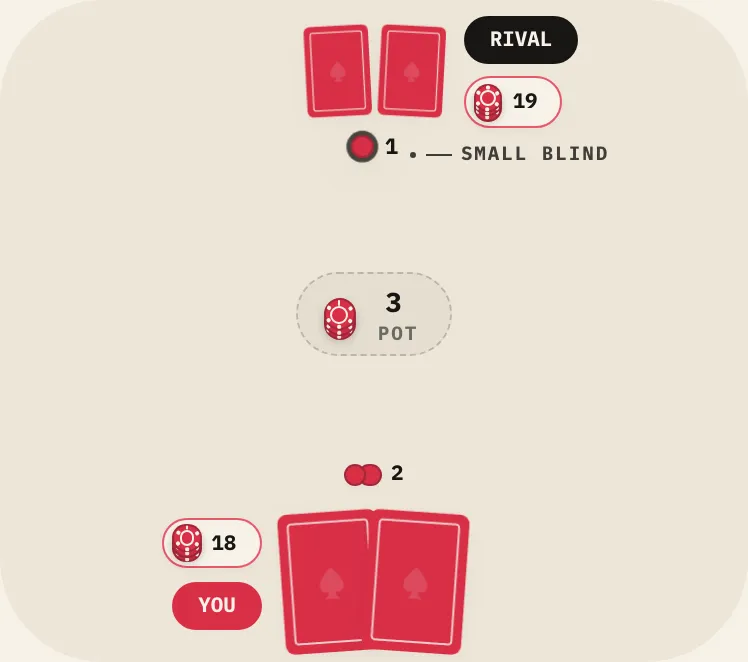
- The small blind is the smaller of the two forced bets, posted by the player directly to the left of the button.
- It's usually half the big blind, and after the flop the small blind acts first.
- In depth Small blind and big blind →
- Big blind BB
-
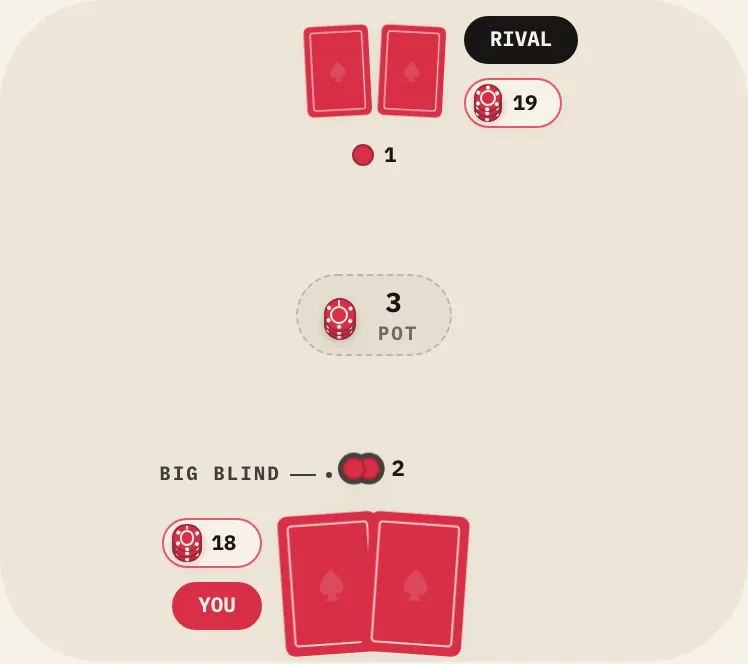
- The big blind is the larger forced bet, usually twice the small blind, posted by the second player to the left of the button.
- It's also the unit stacks are measured in: a stack of 100 big blinds is worth a hundred of them.
- In depth Small blind and big blind →
- Ante
- An ante is a small forced bet that every player puts in before the deal, on top of the blinds.
- Most tournaments now use a single big blind ante instead, paid by the big blind for the whole table.
- Straddle
- A straddle is an optional blind bet, usually twice the big blind, posted before the deal by the player to the left of the big blind.
- It doubles the stakes for that hand and buys the straddler the right to act last before the flop; some rooms allow it from other seats too.
- In depth What is a straddle →
- Position
-
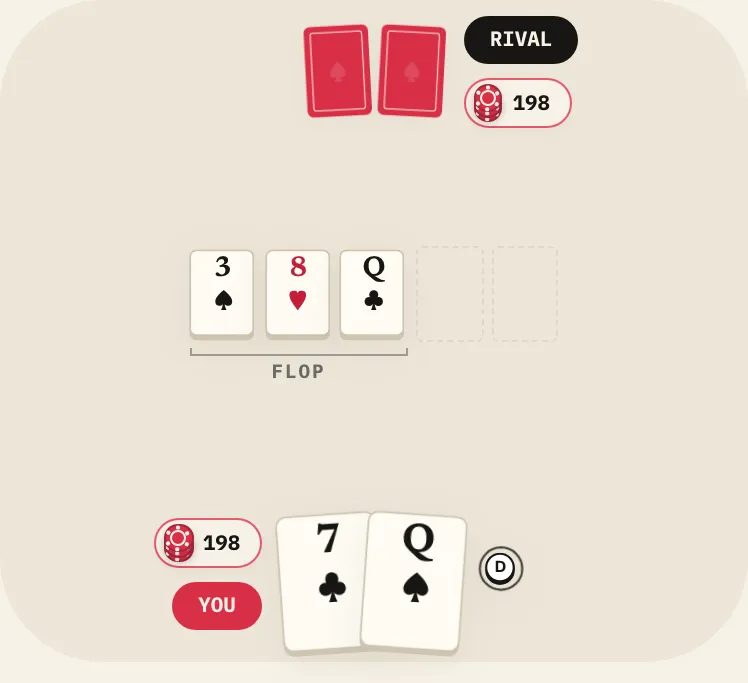
- Position is where you sit relative to the button, which decides the order you act in and how much you know when you do.
- Acting last is an edge that has nothing to do with your cards: you see what everyone else does first.
- In depth Poker positions →
- In position IP
-
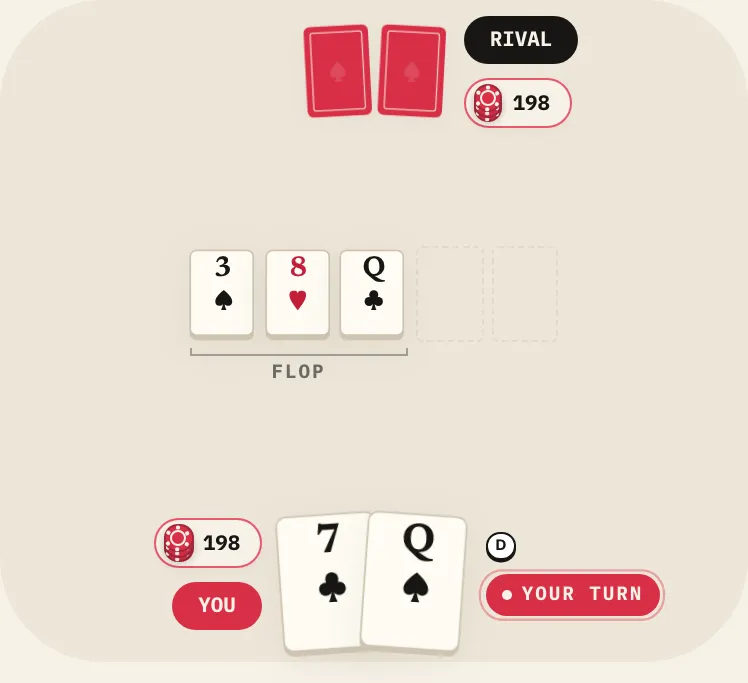
- In position means acting after your opponent on the flop, turn and river, and out of position means acting before them.
- The button is in position on everyone, and the blinds are out of position on almost everyone.
- Early position EP
-
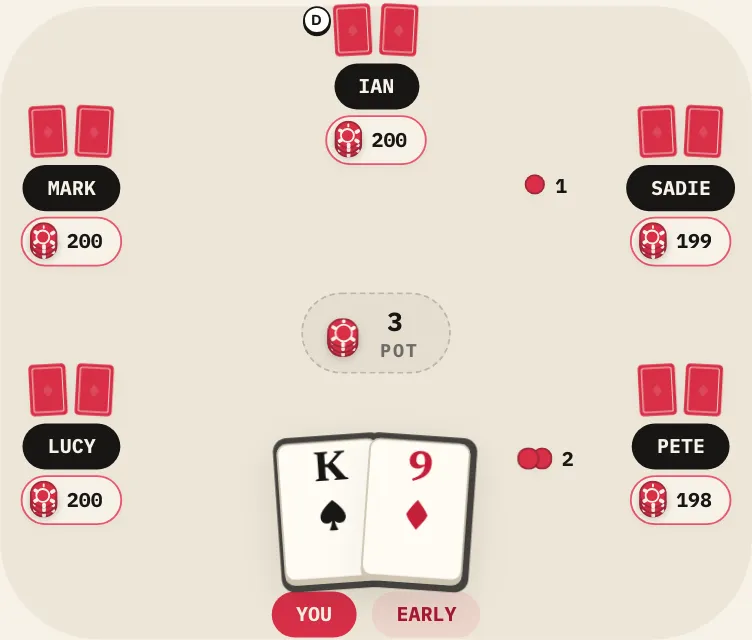
- Early position is the first seats to act before the flop, starting with the player to the left of the big blind.
- It's two seats at a table of nine (some count three) and one at a table of six, and it calls for the strongest hands because so many players act after you.
- Middle position MP
-
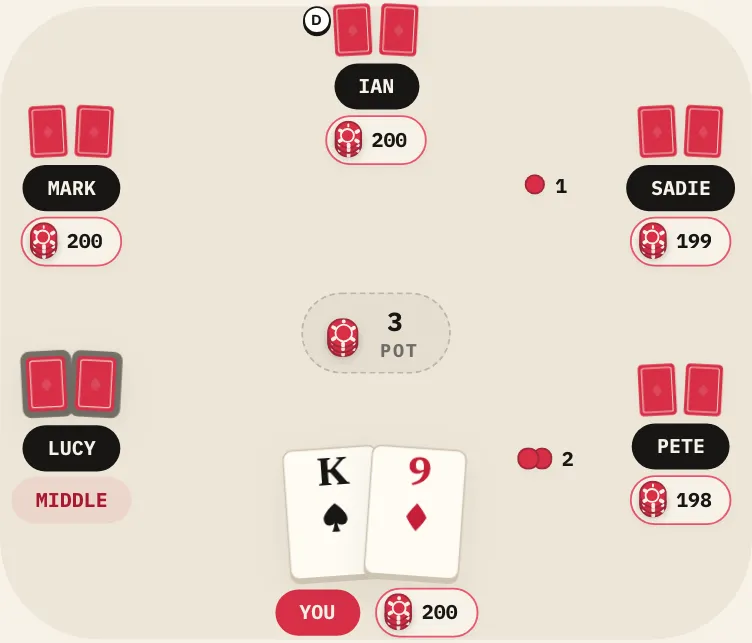
- Middle position is the seats between early and late position: three at a table of nine and one at a table of six.
- With fewer players left to act than in early position, you can play a few more hands here.
- Late position LP
-
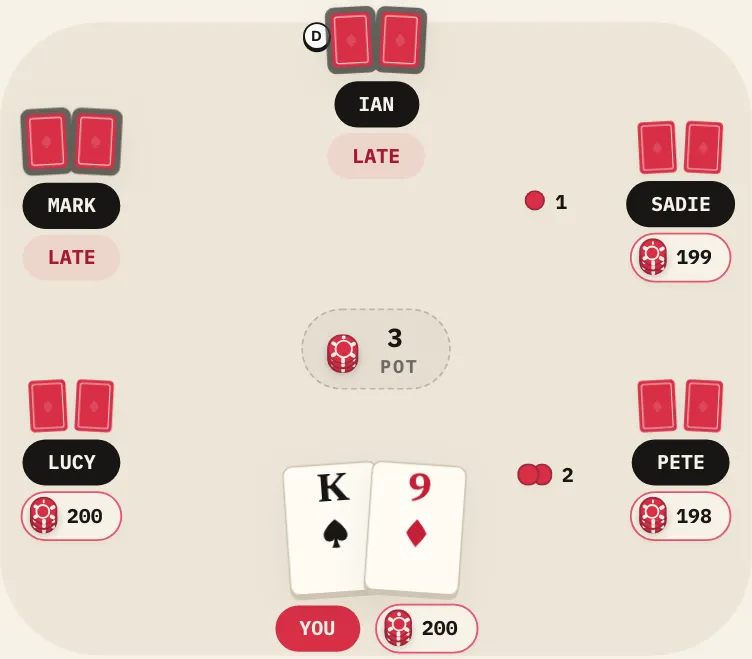
- Late position is the last two seats before the blinds: the cutoff and the button.
- Once the flop is out they act after almost everyone, which is why they can play more hands than any other seat.
- Under the gun UTG
-
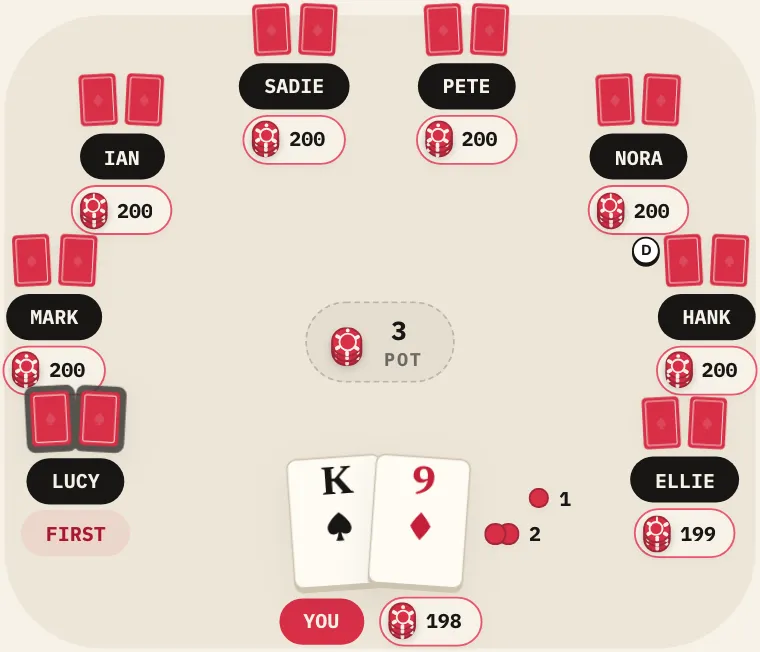
- Under the gun is the seat directly to the left of the big blind, the first to act before the flop.
- With a straddle on, the straddler sits there and the action starts with the player to their left.
- In depth Poker positions →
- Hijack HJ
-
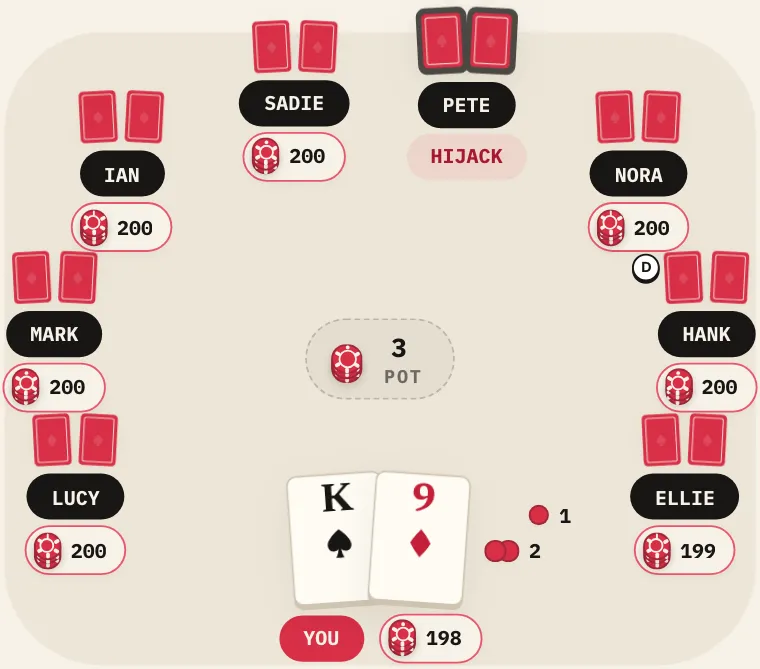
- The hijack is the seat two places to the right of the button, just before the cutoff.
- It's the last seat in middle position, and at a table of six it's the seat right after under the gun.
- In depth Poker positions →
- Cutoff CO
-
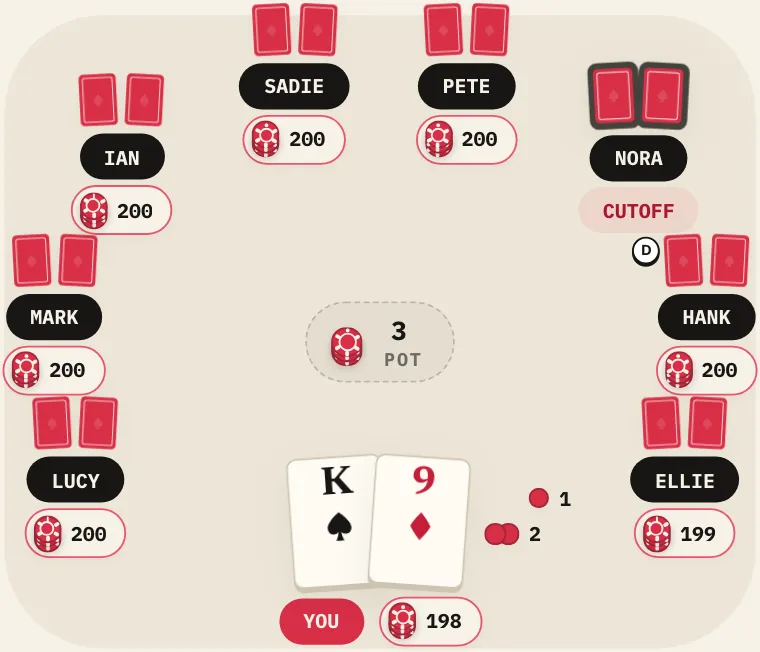
- The cutoff is the seat directly to the right of the button, the last to act before it.
- It's the second-best seat at the table, and when everyone before it folds it can open almost as many hands as the button.
- In depth Poker positions →
- Heads-up HU
-
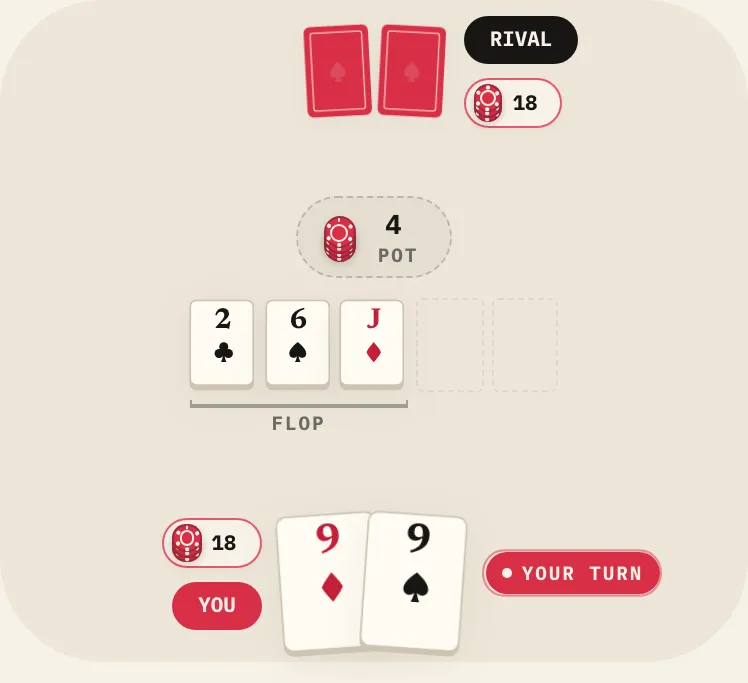
- Heads-up means just two players, either left in a single hand or playing at a table on their own.
- Heads-up the blinds work differently: the button posts the small blind, acts first before the flop and last after it.
- In depth Small blind and big blind →
Hands and draws
What your cards make, and what they could still become.
- Hand (your best five)
-
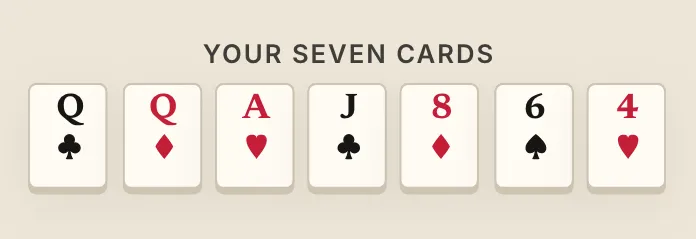
- Your hand is the best five-card combination you can make from your two hole cards and the five on the board.
- It's always exactly five cards, and it can use both of your hole cards, one of them or neither.
- In depth Poker hand rankings →
- Kicker
-
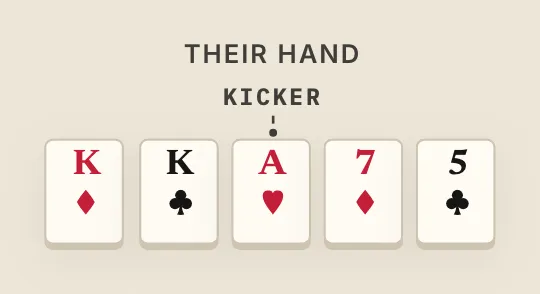
- A kicker is a side card that isn't part of your pair or other combination but still counts to break a tie.
- On a board of K-9-5-3-2, king-queen beats king-jack: both have a pair of kings, and the queen outranks the jack.
- In depth Who wins in poker →
- Playing the board
-
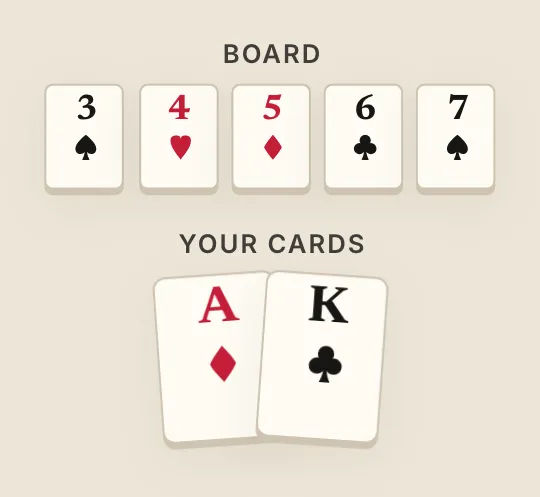
- Playing the board is when your best five cards are the five on the board, so your hole cards add nothing.
- The most you can do then is split the pot with everyone else who can't beat the board either.
- Top pair
-
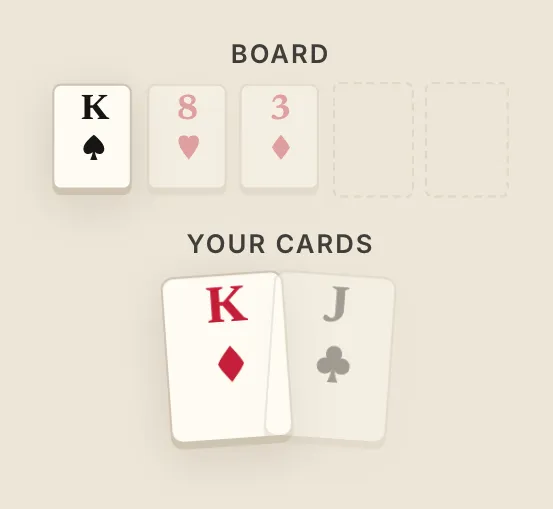
- Top pair is a pair made with the highest card on the board, like a king in your hand on a flop of K-8-3.
- It's often the best hand on the flop, and how good it is depends on your kicker.
- Overpair
-
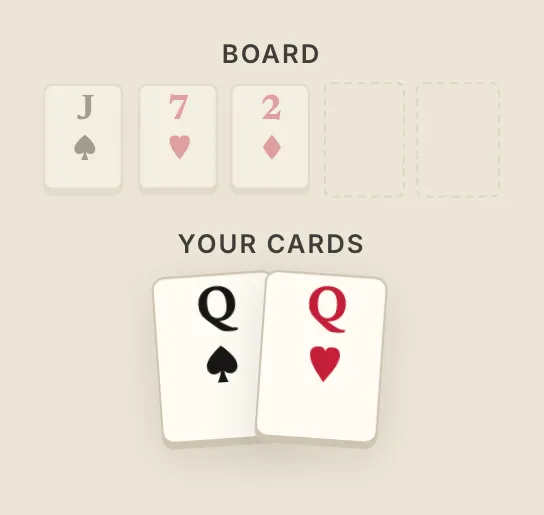
- An overpair is a pocket pair higher than every card on the board, like two queens on a flop of J-7-2.
- It beats top pair and any smaller pair, but not a bigger pocket pair, two pair or a set.
- Overcards
-
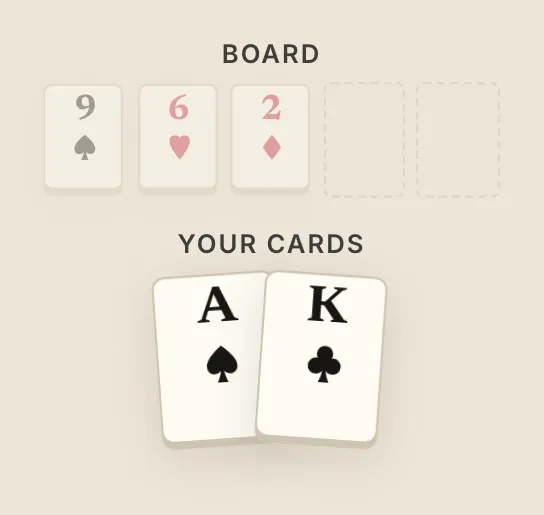
- Overcards are hole cards higher than every card on the board, like ace-king on a flop of 9-6-2.
- With two overcards and no pair you have six outs to make top pair, three for each card.
- Set
-
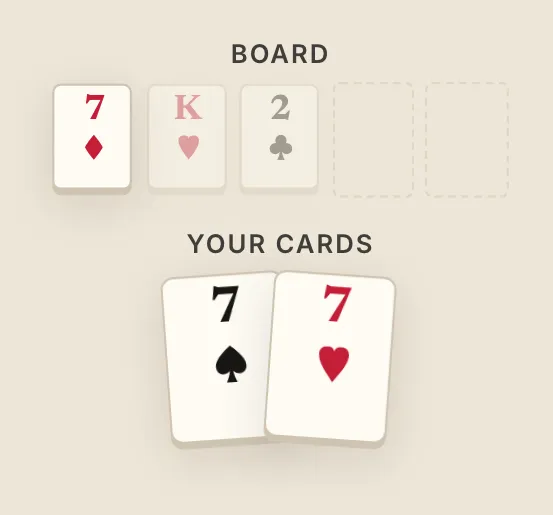
- A set is three of a kind made with a pocket pair and one matching card on the board.
- A pocket pair flops a set or better about 12% of the time, and because the pair is hidden, a set is hard to see coming.
- Trips
-
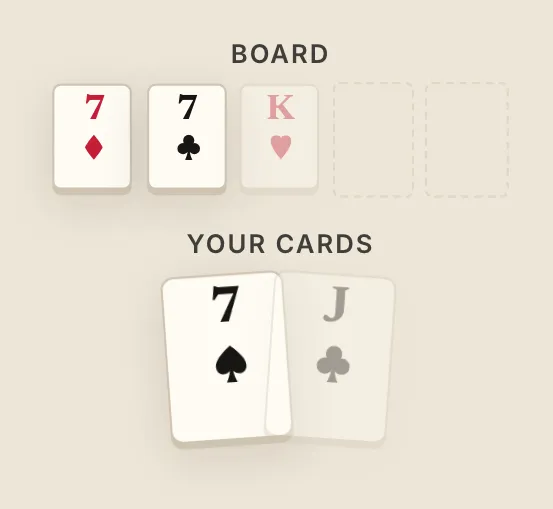
- Trips is three of a kind made with one card in your hand and a pair on the board.
- It's easier to spot than a set, and because the pair is shared, another player may hold the same card with a better kicker.
- The nuts
-
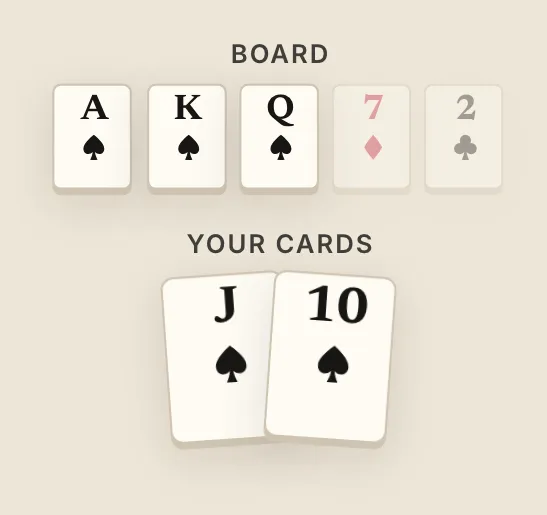
- The nuts is the best possible hand given the cards on the board at that moment.
- It can change with every card: on a flop of 9-8-7 in three suits, jack-ten is the nuts until the turn changes the board.
- Slang monster
- Wheel
-
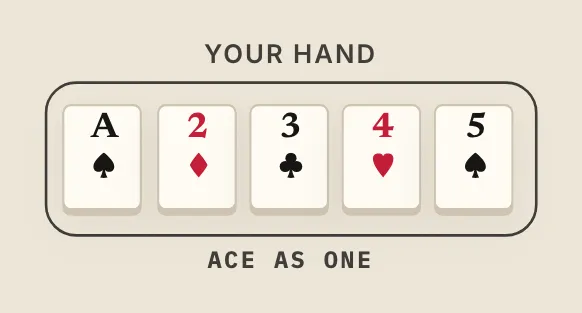
- The wheel is the lowest straight, A-2-3-4-5, with the ace playing as the lowest card.
- It's a five-high straight, so a straight from 2 to 6 beats it.
- Draw
-
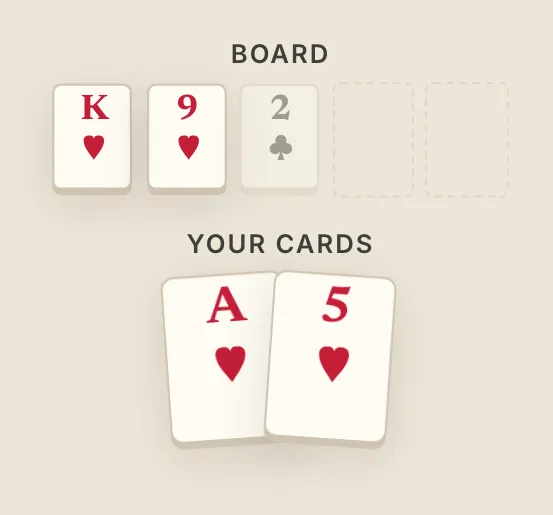
- A draw is a hand that isn't made yet but can become one with the right card, like four cards to a flush.
- Its opposite is a made hand, one that's already complete, and a draw wins nothing until it gets there.
- Slang runner-runner
- In depth Reading the flop →
- Flush draw
-
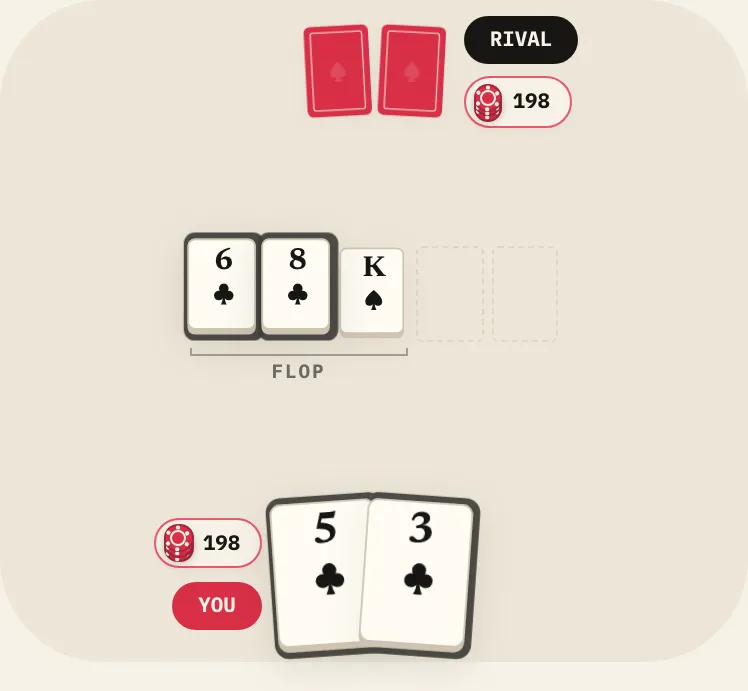
- A flush draw is four cards of the same suit, needing one more to make a flush.
- It has 9 outs: from the flop it gets there by the river about 35% of the time, and from the turn about 20%.
- Open-ended straight draw OESD
-
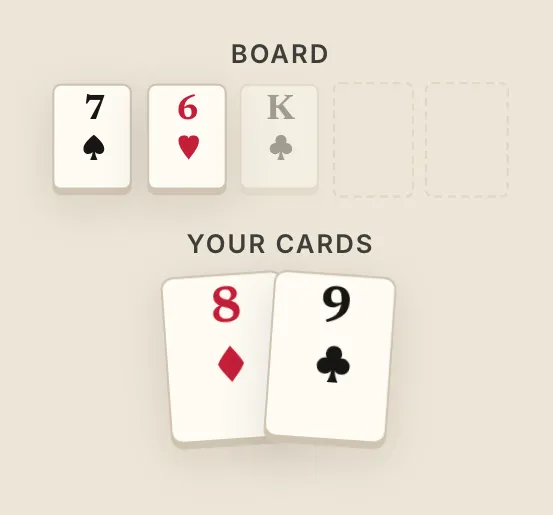
- An open-ended straight draw is four cards in a row that can become a straight at either end, like 8-7-6-5 waiting on a 9 or a 4.
- It has 8 outs and gets there by the river about 31% of the time from the flop, and about 17% from the turn.
- Gutshot
-
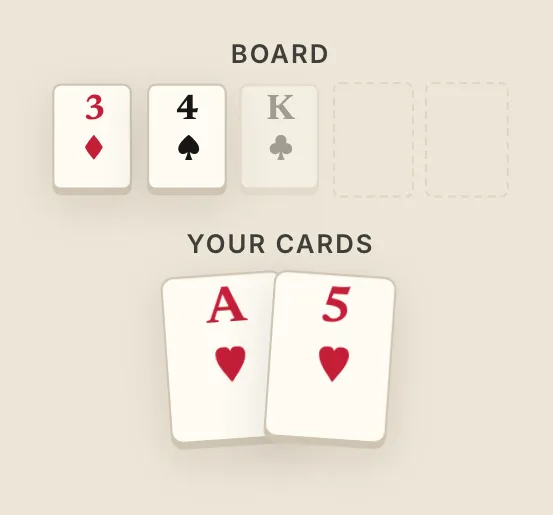
- A gutshot is a straight draw missing one card in the middle, like 9-8-6-5 waiting on a 7.
- It has only 4 outs, half as many as an open-ended draw, and gets there about 16% of the time from the flop.
- Slang gutter
- Outs
-
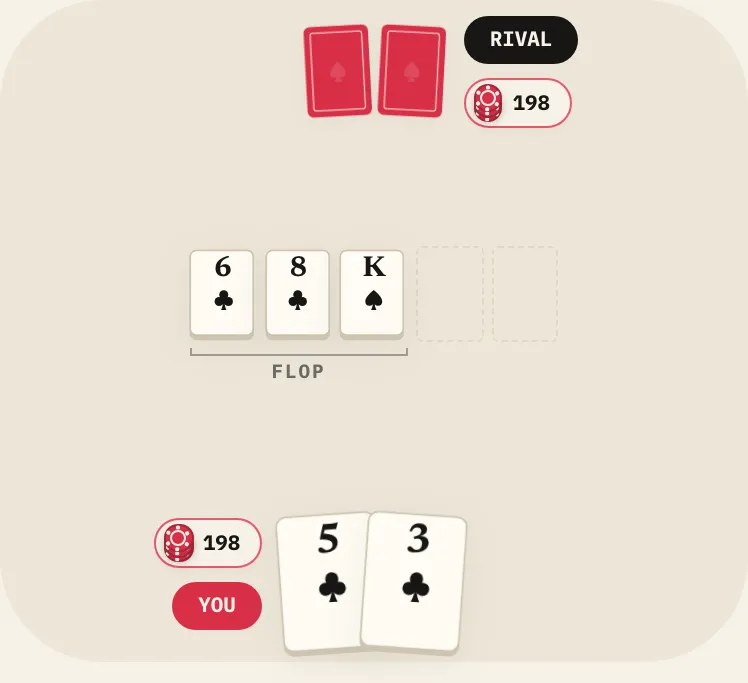
- Outs are the cards left in the deck that would turn your hand into the best one.
- For a quick estimate, multiply your outs by 4 on the flop and by 2 on the turn to get a rough percentage.
- Slang brick
- In depth Reading the flop →
Chips and pots
How bets are counted, capped and split.
- Chip
-
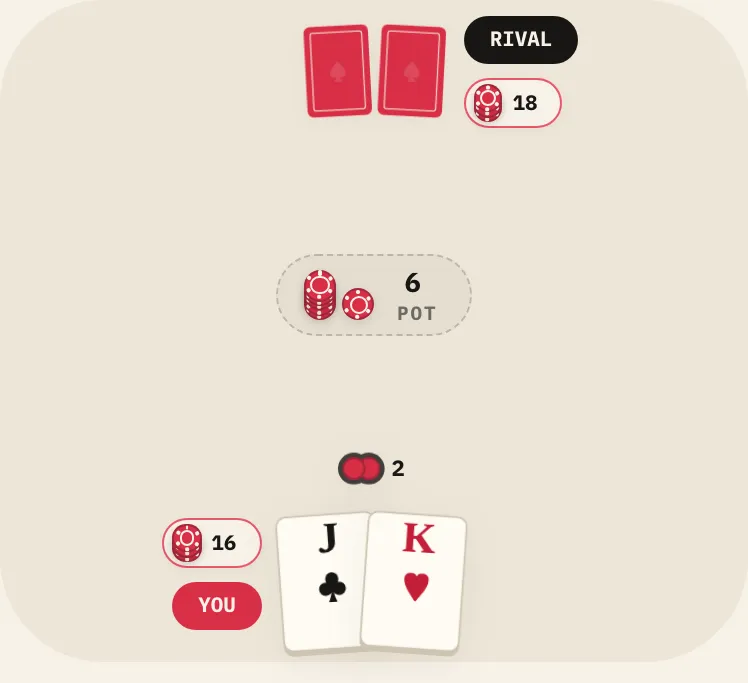
- A chip is the token you bet with, and its value exists only inside the game.
- In Pokeo chips can't be bought and aren't worth money: they're how you keep score of your decisions.
- In depth Poker chip values →
- Stack
-
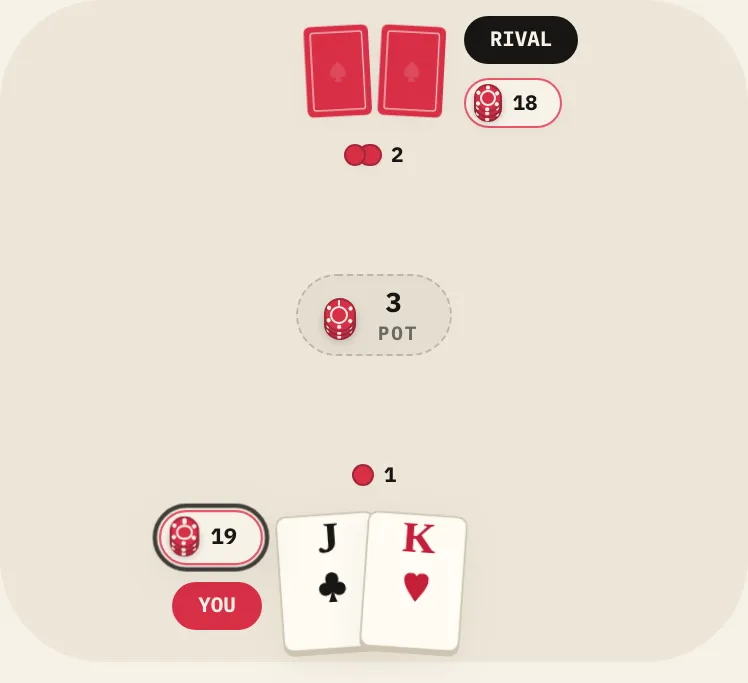
- Your stack is the chips you have in front of you, which is also the most you can lose in a single hand.
- It's counted in big blinds rather than chips, and 100 big blinds is the usual starting stack in a cash game.
- Slang felted
- In depth Poker chip values →
- Short stack
- A short stack is one worth only a few big blinds, which leaves little room for anything but going all-in or folding.
- In tournaments, rising blinds turn deep stacks into short ones.
- Effective stack
- The effective stack is the smaller of two stacks facing each other, since no one can win more from an opponent than that opponent has.
- If you have 300 and your opponent has 120, the two of you are really playing for 120.
- Cover
-
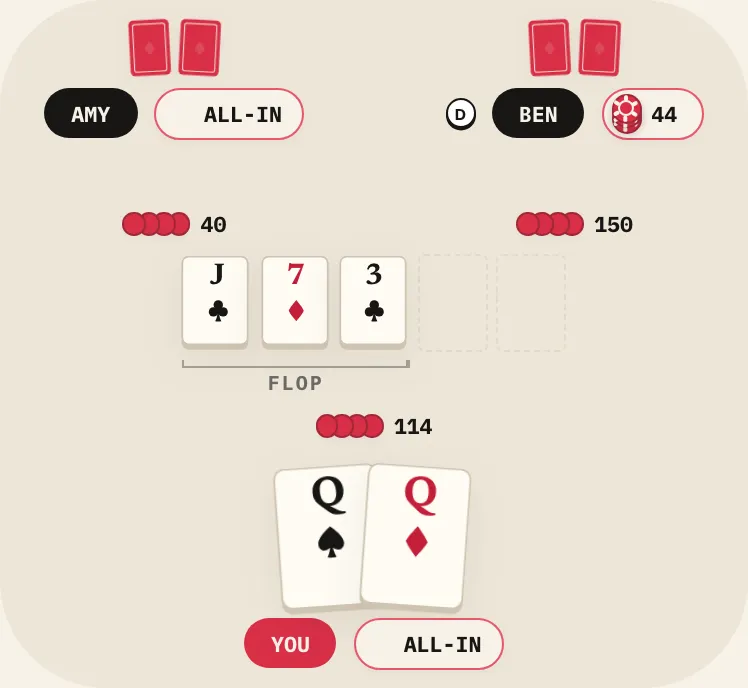
- To cover a player is to have at least as many chips as they do, so you can match everything they bet.
- If someone covers you and you go all-in and lose, you're out of chips.
- Pot
-
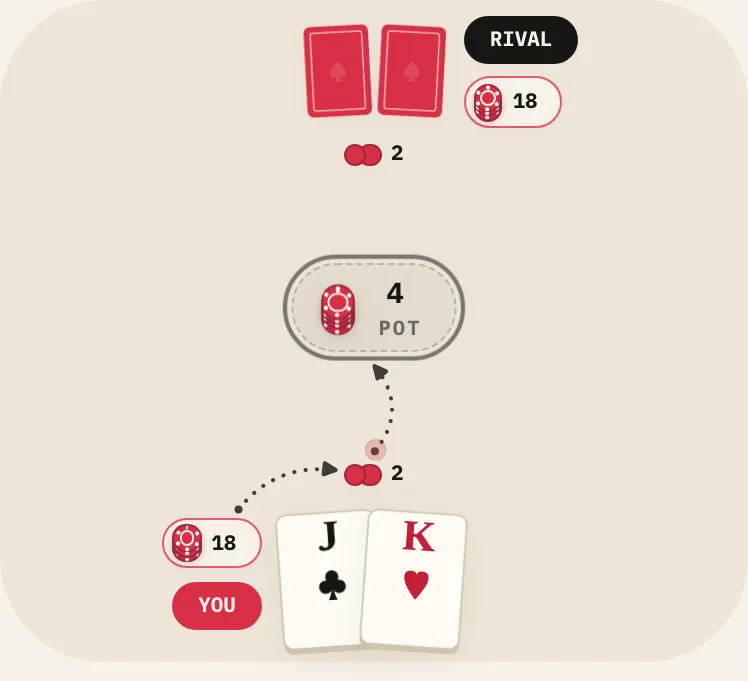
- The pot is all the chips bet in a hand, gathered in the middle of the table, and it goes to whoever wins.
- When two players tie exactly, it's split between them.
- Slang ship it · splash the pot
- Main pot
-
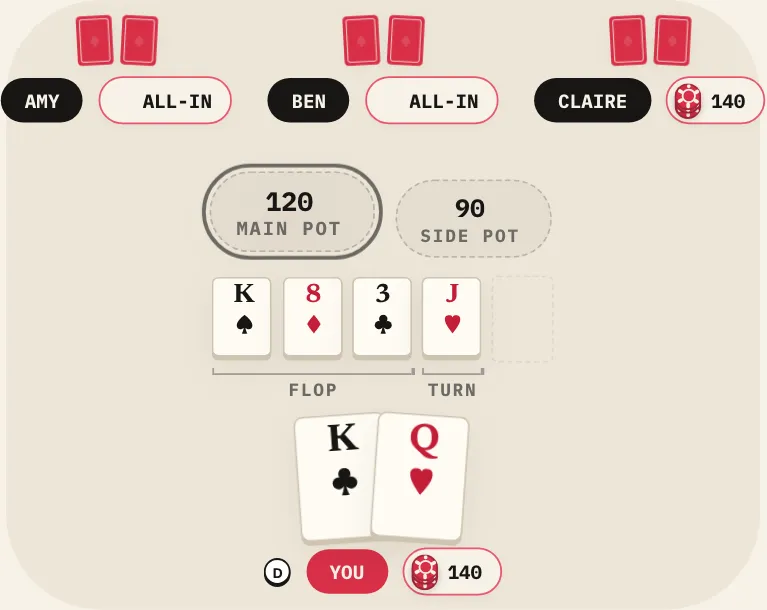
- The main pot is the part of the pot every player still in can win, including a player who's all-in for less.
- The all-in player can only win this one: the same amount from each player, up to what they put in themselves.
- Side pot
-
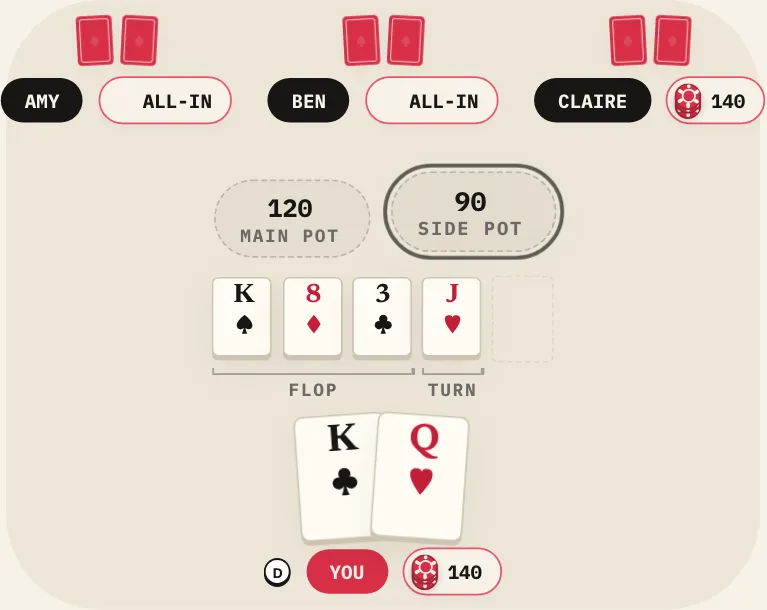
- A side pot is a separate pot made of the chips bet beyond a player's all-in, which only the players who put chips in it can win.
- With several all-ins of different sizes there can be several side pots, paid one by one, starting with the last one made.
- In depth Who wins in poker →
- Split pot
-
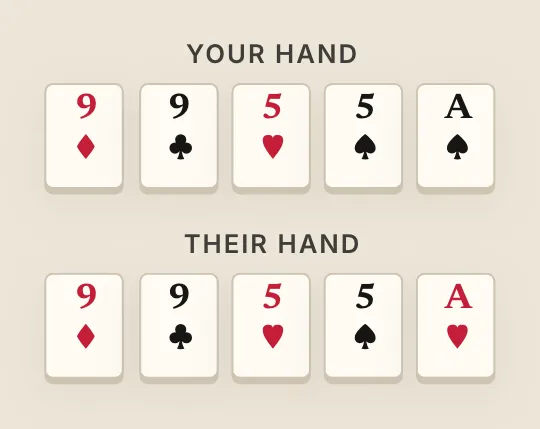
- A split pot is a pot divided equally between two or more players whose hands are of exactly the same value.
- Suits never break a tie, and if the chips don't divide evenly, the odd chip goes to the first winner to the left of the button.
- Slang chop
- In depth Who wins in poker →
- Short all-in
-
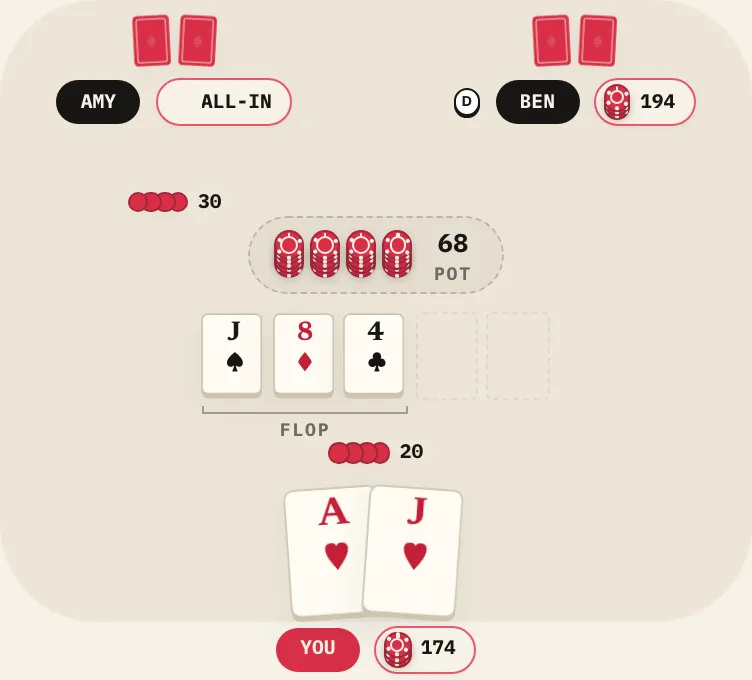
- A short all-in is an all-in that adds less than a full raise, the minimum the rules would otherwise require.
- It doesn't reopen the betting: players who have already acted can only call or fold, unless several all-ins add up to a full raise.
- No-limit NL
- No-limit is the betting structure in which you can bet or raise any amount, up to all your chips, whenever it's your turn.
- It's how Texas Hold'em is usually played; in limit games bets come in fixed sizes, and in pot-limit no bet can be bigger than the pot.
Odds and strategy
The words players use to think a hand through.
- Pot odds
-
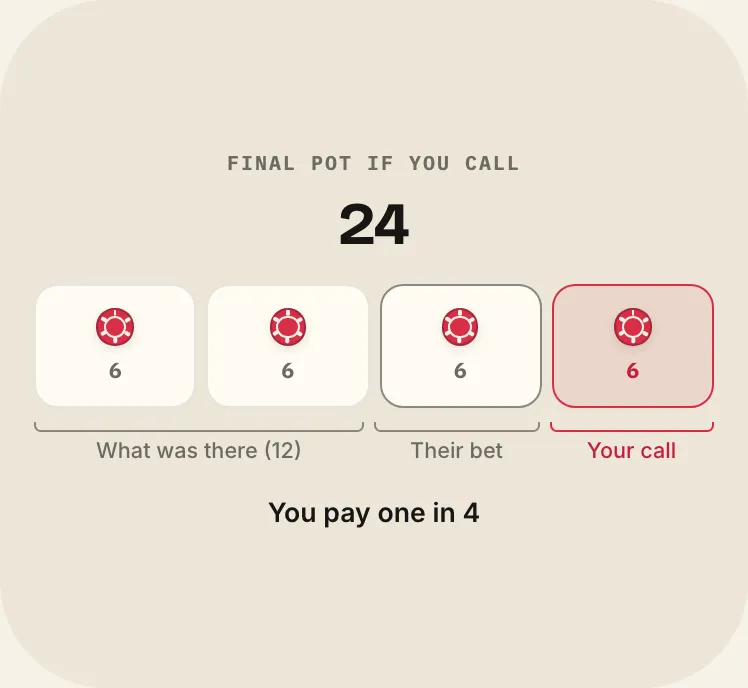
- Pot odds are the price of a call: what you have to put in compared with what the pot will be once you do.
- If you call 50 to make a pot of 200, you're paying a quarter of it, so calling breaks even if you win one time in four.
- In depth Pot odds →
- Implied odds
- Implied odds are pot odds that also count the chips you expect to win on later streets if your draw comes in.
- They're why a call that looks too expensive now can still be right, but only if your opponent will actually pay you off.
- In depth Pot odds →
- Equity
- Equity is the share of the pot your hand is worth: how much of it you'd win on average if the rest of the hand were dealt out many times.
- The percentages next to each player on a poker broadcast are their equity at that moment.
- Expected value EV
- Expected value is what a decision wins or loses on average if you could make it many times over.
- It's written EV, and a play is +EV when it gains on average, even if it loses this particular time.
- Range
-
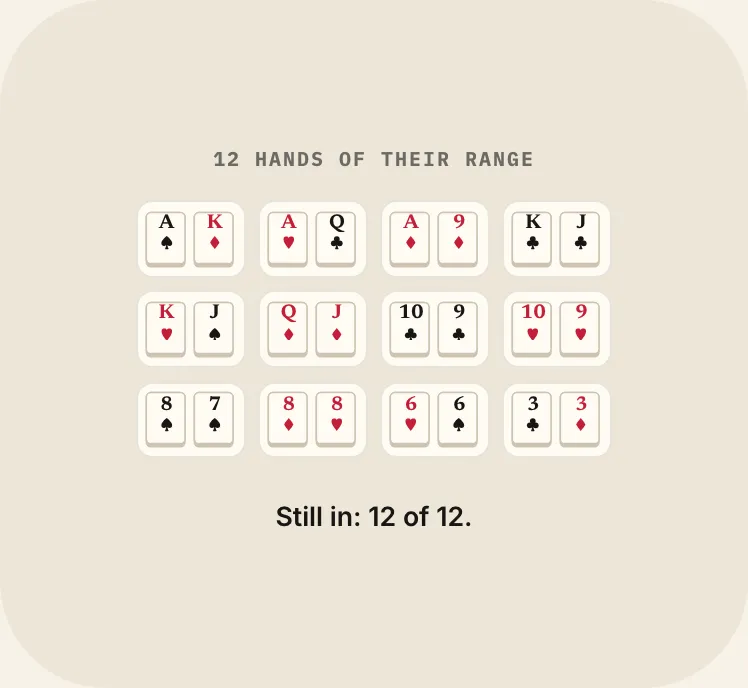
- A range is the whole list of hands a player could have, given everything they've done in the hand so far.
- You'll rarely know an opponent's two cards, but you can know which hands make sense.
- In depth Poker ranges →
- Board texture
-
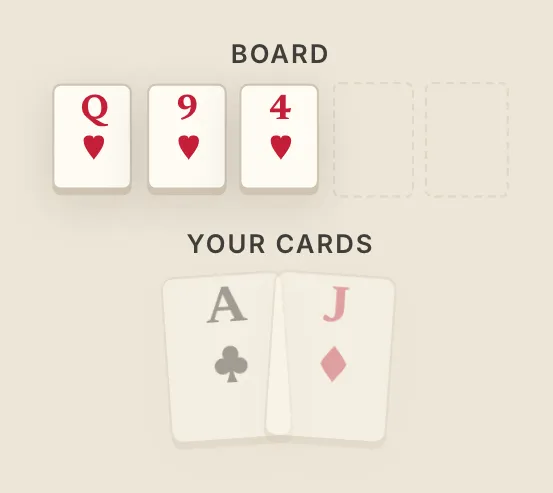
- Board texture is how the cards on the board fit together: a dry board allows few straights or flushes, and a wet one allows many.
- K-7-2 in three suits is dry; 9-8-7 with two hearts is wet.
- In depth Reading the flop →
- GTO
- GTO, short for game theory optimal, is a strategy that can't be exploited, worked out by computer programs called solvers.
- Commentators use it as shorthand for the textbook play, which isn't always the play that wins the most against a particular opponent.
- Variance
- Variance is the gap between what your decisions should win on average and what you actually win over a stretch of hands.
- It's why a good decision can lose and a bad one can win, and why one night's results prove very little.
Players and slang
What players call each other, and the hands they'd rather forget.
- Tight
-
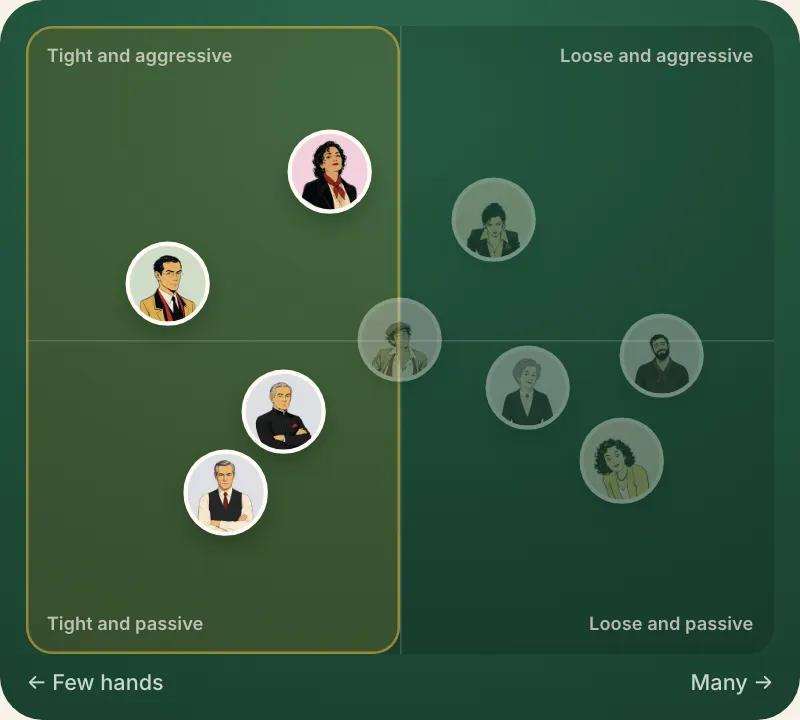
- Tight describes a player who plays few hands and only gets involved with strong cards.
- Tight-aggressive, or TAG, is the classic winning style: few hands, played with bets and raises.
- Slang TAG
- Loose
-
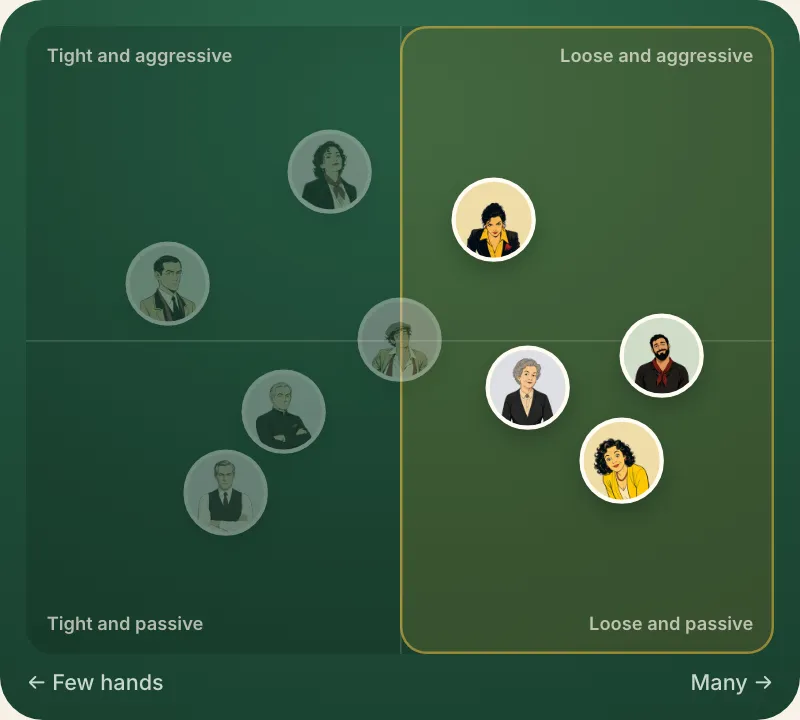
- Loose describes a player who plays a lot of hands, including cards a tighter player would fold.
- Loose-aggressive, or LAG, is hard to play against; loose-passive is the easiest style there is to beat.
- Slang LAG
- Aggressive
-
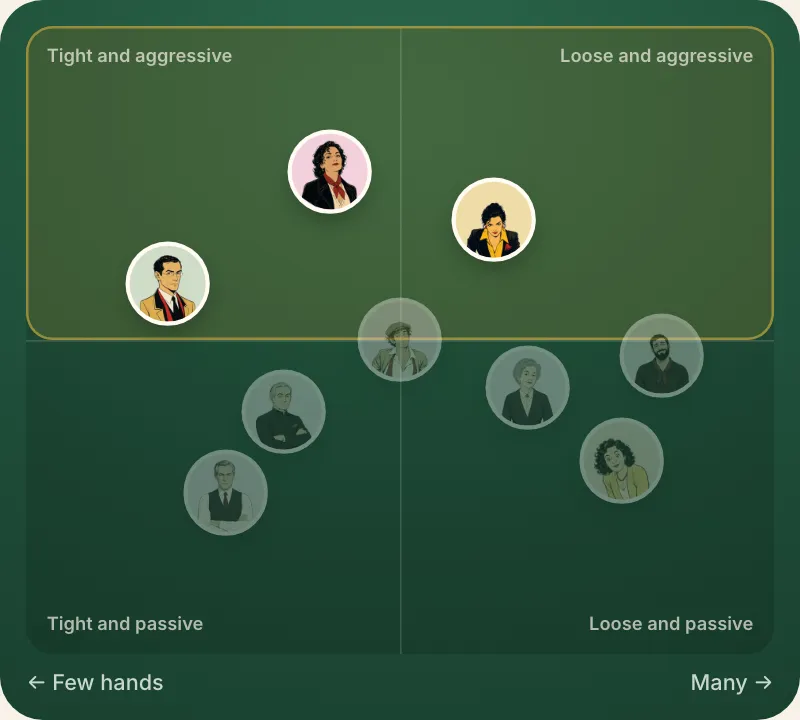
- Aggressive describes a player who bets and raises far more often than they check and call.
- Aggression wins pots without a showdown, because every bet gives the other players a chance to fold.
- Passive
-
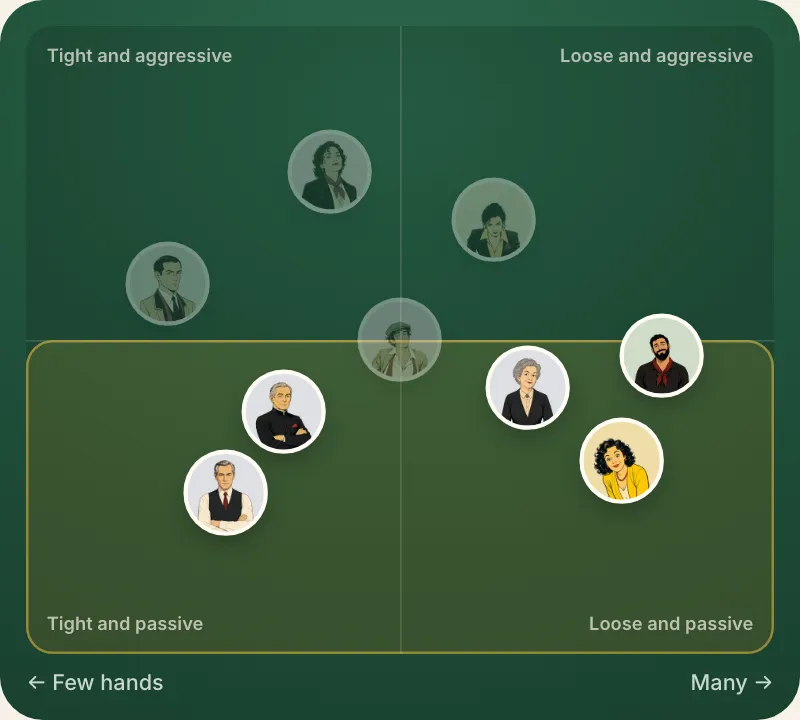
- Passive describes a player who checks and calls far more often than they bet and raise.
- Against a passive player, a sudden bet or raise usually means a strong hand.
- Fish
- A fish is a weak player who loses chips to better ones, usually by calling too much.
- As the old line goes, if you can't spot the fish at the table, it's you.
- Slang donk
- Nit
- A nit is an extremely tight player who waits for premium hands and almost never bluffs.
- When a nit finally raises, believe them.
- Slang rock
- Reg
- A reg, short for regular, is a player who plays often at the same tables and knows the game well.
- On a stream, a table full of regs means a tough table, with no easy chips.
- Maniac
- A maniac is a hyper-aggressive player who bets and raises with almost any two cards.
- They're scary and expensive to play against, and the best answer is usually patience and strong hands.
- Calling station
- A calling station is a player who calls almost every bet and rarely folds or raises.
- You can't bluff one, but you can bet your good hands for value all the way to the river.
- Tilt
- Tilt is playing worse than usual because of frustration or anger, often after a painful hand.
- A player on tilt plays hands they'd normally fold and calls bets they'd normally let go; the fix is a break, not more hands.
- Bad beat
- A bad beat is losing a hand you were a big favorite to win when the chips went in, because a lucky card came for your opponent.
- Everyone has a bad beat story, and almost no one wants to hear yours.
- Slang suckout
- Cooler
- A cooler is a hand where a very strong hand runs into an even stronger one, so losing a lot was nearly impossible to avoid.
- Kings against aces before the flop, or a set against a higher set, are the classic coolers.
Games and room rules
The games you'll get invited to, and the rules a card room enforces.
- Home game
- A home game is a private game among friends, played at someone's place with house rules agreed on beforehand.
- There's no dealer, so the deal rotates with the button, and any rule worth arguing about is best settled before the first hand.
- In depth Hosting a poker night →
- Cash game
- A cash game is a game in which the chips stand for real money, the blinds never change and you can join or leave whenever you like.
- It's the opposite of a tournament; Pokeo has neither money nor tournaments, only chips you can't buy.
- Tournament
- A tournament is a competition in which everyone starts with the same chips, the blinds go up on a schedule and play goes on until one player has them all.
- Tournament chips aren't money: once you lose yours you're out, unless the event allows a rebuy.
- Buy-in
- The buy-in is what it costs to take part: the entry fee of a tournament, or the chips you sit down with in a cash game.
- Cash tables set a minimum and a maximum, and in a home game the host decides.
- Rake
- The rake is the small cut a card room takes from each pot in a cash game, or adds to the entry fee of a tournament.
- It's how card rooms pay for dealers and tables; a home game has no rake, and neither does Pokeo.
- Texas Hold'em
-
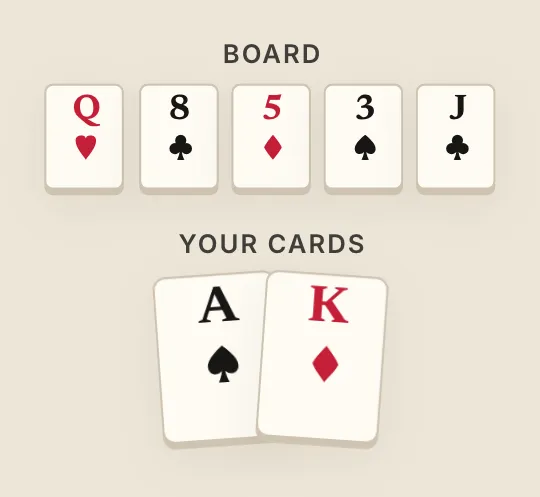
- Texas Hold'em is the most played form of poker: two hole cards each, five shared cards on the board, and the best five of seven wins.
- It's the game you see on TV and on streams, almost always played no-limit.
- In depth Texas Hold'em rules →
- Omaha
- Omaha is a poker game like Hold'em but with four hole cards, of which you must use exactly two, together with three from the board.
- It's usually played pot-limit, which is what PLO stands for, and the hands run much bigger than in Hold'em.
- In depth Texas Hold'em rules →
- Five-card draw
- Five-card draw is the classic poker of the movies: five hidden cards each, one chance to swap some of them, and two betting rounds.
- There's no board, so all you learn about an opponent's hand is how many cards they drew.
- In depth Five-card draw →
- Short-handed
- Short-handed describes a table with six players or fewer, where the blinds come around faster and more hands are worth playing.
- Six-seat tables are often called 6-max, and a full ring is a table of nine or ten.
- Floor
- The floor is the card room supervisor who settles disputes and rule questions at the tables.
- When a dealer calls “floor!”, play stops until the floor arrives and rules, and the ruling stands.
- Slang clock
- Verbal declaration
- A verbal declaration is saying your action out loud in turn, such as “call” or “raise to 30”, and it binds you to that action.
- The movie line “I'll see your bet and raise” doesn't work at a real table: “see” is a call, and that's all you did.
- String bet
- A string bet is putting chips in with more than one forward motion without announcing the amount first, and it isn't allowed.
- Only the first motion counts, so to raise, either say the amount or put all the chips in at once.
- Oversized chip
- An oversized chip is a single chip worth more than the bet you face, and putting it in without saying “raise” first counts as a call.
- The dealer gives you change; to raise with it, say so before the chip lands on the table.
- Acting out of turn
- Acting out of turn is folding, calling or betting before the action reaches you.
- It can bind you to that action, and it gives information away to the players who haven't acted yet, so wait.
- Protect your hand
- To protect your hand is to keep a chip or your hand on top of your cards, so they can't be mucked by mistake.
- If the dealer sweeps unprotected cards into the muck, the hand is usually dead, and the rules side with the dealer.
- Cards speak
- Cards speak is the rule that the cards you show decide the pot, not what you say you have.
- Always turn both cards face up at showdown: a hand that isn't shown can't win, and one its owner misreads still can.
- Misdeal
- A misdeal is a deal declared void and dealt again, for example because one of the first two cards came out face up or a player got the wrong number of cards.
- Once there's been real betting, it's usually too late: the hand plays on.
- Run it twice
- To run it twice is to deal the rest of the board two separate times after an all-in, splitting the pot between the two results.
- Both players have to agree, and it doesn't change what anyone wins on average, only how much the results swing.
At the table and on streams
Slang you'll hear
Players rarely use the textbook word. Here's what they say instead, and the plain term it stands for.
- Angle shooting
- cheap tricks
- Using a technically legal move, like a fake call or a misleading gesture, to gain an edge.
- Card dead
- no playable hands
- Dealt nothing worth playing for a long stretch.
- Chop
- split the pot
- Also what the blinds do when everyone folds to them and they agree to take their chips back.
- Dead man's hand
- aces and eights
- Two pair, black aces and black eights, said to be what Wild Bill Hickok held when he was shot in 1876.
- The hammer
- seven-deuce offsuit
- The worst starting hand in Hold'em; winning a pot with it is a running joke.
- Rabbit hunt
- see what would have come
- Dealing the cards that would have come after a hand ends, just to look; most rooms don't allow it.
- Railbird
- a spectator
- Someone watching from the rail, the edge of the playing area.
- Runner-runner
- a two-card draw
- A hand made by the right card on both the turn and the river; also called a backdoor draw.
- Shark
- a strong player
- A skilled player who feeds on weaker ones.
- Slow roll
- showing a winner slowly
- Taking your time to show a winning hand at showdown, one of the rudest things you can do at a table.
- Splash the pot
- throw chips in
- Tossing chips into the middle so nobody can count them; put them in front of you instead.
- Tank
- think it over
- To take a long time before acting; a tank-fold is a long think that ends in a fold.
Every definition follows standard Texas Hold'em rules, with Robert's Rules of Poker and the TDA rules for card-room questions, and every percentage was recalculated. How we checked
Glossary index
By topic
- CardsThe cards 11
- StreetsA hand, street by street 11
- ActionsActions 17
- SeatsSeats and position 15
- HandsHands and draws 15
- PotsChips and pots 11
- OddsOdds and strategy 8
- PlayersPlayers and slang 12
- RulesGames and room rules 18
- Slang you'll hear 39
A to Z
- Sandbagging slow play
- Semi-bluff
- Set
- Ship it push me the pot
- Short all-in
- Short stack
- Short-handed
- Shove all-in
- Showdown
- Side pot
- Slow play
- Slow roll showing a winner slowly
- Small blind
- Snap call an instant call
- Snowmen pocket eights
- Splash the pot throw chips in
- Split pot
- Stack
- Straddle
- Street
- String bet
- Suckout a lucky win
- Suit
- Suited
Keep going
 If you play Balatro
From Balatro to poker
The hands you already know, the three that don't exist and what a real table adds.
 The deck
How many cards in a deck
All 52 drawn, the face cards and how many come out in a hand.
 The legend
The dead man's hand
Aces and eights, Wild Bill Hickok, and what the hand is really worth.
What's next?
A glossary gets you unstuck; it doesn't teach you to play. In the course the words come one at a time, each on the table just when you need it, starting with the most basic thing of all: reading a card.
First lesson · 6 min The cards Every card has two facts: rank and suit. You'll learn to read both, and which one says which card is worth more. Play nowNo sign-up · No money · In your browser